Muslim wedding in Bali: the KUA process, step by step
The ijab kabul is one sentence. Here is everything that has to be ready before it, in the order the KUA actually works: the letters from home, the documents, the 10-working-day deadline, the guidance course, and the buku nikah you collect after.
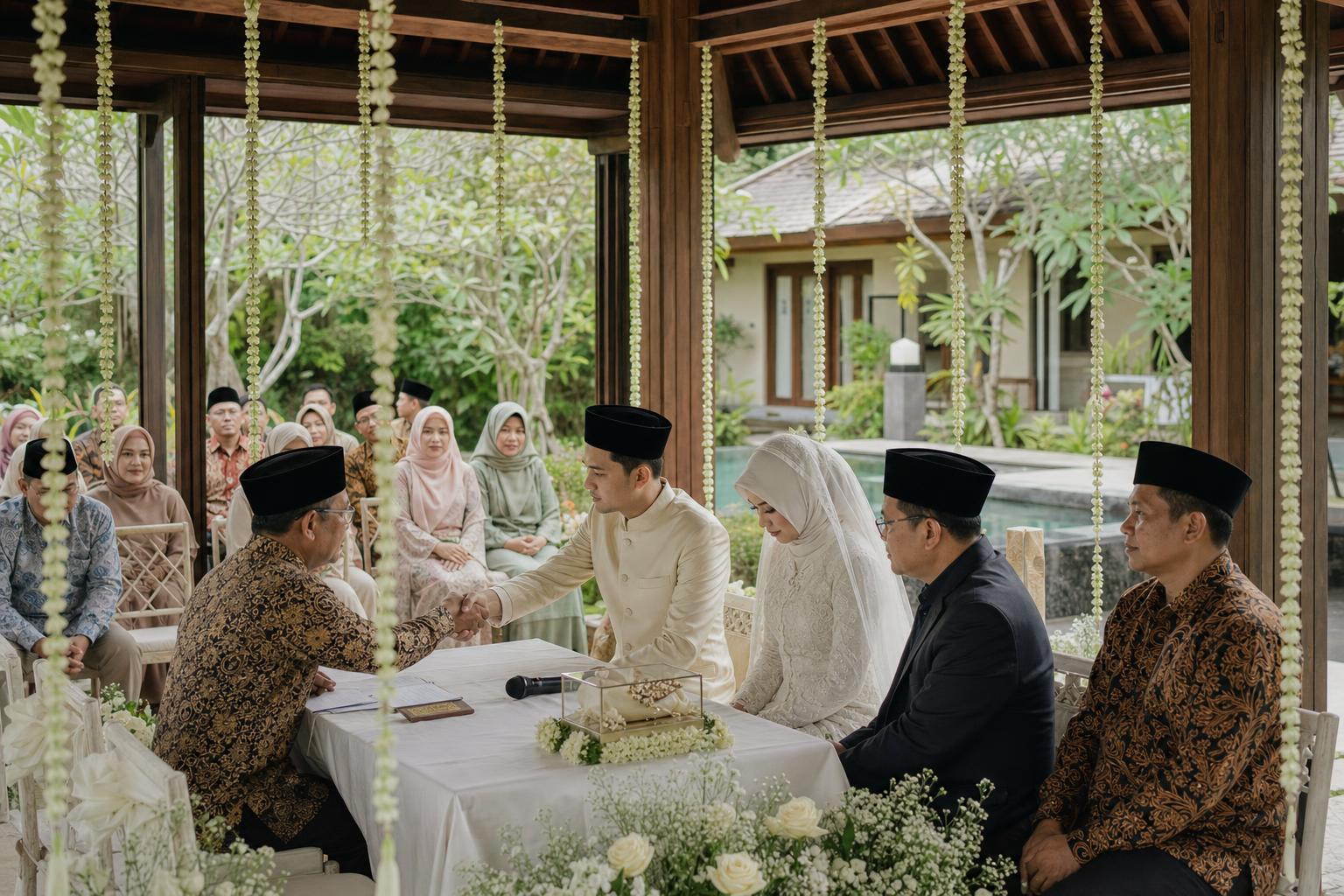
A Muslim marriage comes down to one sentence: the ijab kabul, the offer and the acceptance, spoken by the groom in one clear breath in front of the witnesses. Once it is said and heard, you are married.
Everything in this guide is what has to be ready before that sentence, and the one document you collect after it. There are ten steps. Some have to wait for another to finish, others can run side by side, and knowing which is which is where couples save the weeks they usually lose. It works the same whether you are both Indonesian or one of you is from overseas.
One condition comes before all ten. For a Muslim marriage, you both need to be Muslim. If one of you is not, that partner converts first, becomes a mualaf, and receives a surat keterangan mualaf, the conversion certificate. In Bali, a convert who was previously Hindu may also be asked for a surat keterangan mepamit, a letter confirming they have taken leave of their former faith community. The KUA will tell you how the conversion is recorded in your case. If you are still working out whether a legal wedding in Indonesia fits you at all, start with can you get married in Bali legally?
I recorded the whole process as a video too, if you would rather watch it:
The office behind every step: the KUA
The Kantor Urusan Agama, the Office of Religious Affairs, handles every Muslim marriage in Indonesia. The one that matters to you is the KUA of the sub-district where your akad will be held. It checks your file, sends the official who conducts the akad, records the marriage, and issues your buku nikah, the marriage book that is your Indonesian marriage certificate.
The rules it works from are set nationally by the Minister of Religious Affairs’ regulation on marriage registration (PMA No. 30 of 2024). Each office still runs its own checklist, so the list your KUA gives you beats any list you find online, including the one below.
Step 1: call the KUA where the akad will happen
Do this before you collect a single paper, because almost every later step depends on what that office tells you. Tell them where you both live, your nationalities, your preferred date, and where you would like the akad held. If either of you has been married before, say so in this first conversation.
Ask for the written document list and the name of the person who will handle your file.
One point that matters in Bali specifically: the akad is registered by the KUA of the sub-district where it takes place. If neither of you lives there, ask what they need from your home KUA.
Step 2: get your letters from home
Your file starts at your village or ward office, the desa or kelurahan, which issues your surat pengantar nikah, the introduction letter for the marriage. You will see it called model N1 on the form, and the head of your village or ward signs it.
Most couples marrying in Bali live somewhere else, which means a second letter: the surat rekomendasi nikah, a recommendation from your home KUA so the Bali KUA can take your marriage.
Start both the day you finish step 1. These letters come from offices in your home area, on their schedule, and you cannot lodge your file in step 4 without them.
Step 3: gather your documents while the letters move
You can collect everything else while step 2 is in motion. It commonly includes:
- KTP, the national identity card, and your kartu keluarga, the family card
- Akta kelahiran, your birth certificate
- A consent form signed by both of you, plus parental permission if either of you is under 21 (the legal minimum age to marry is 19)
- A health check and fitness-to-marry certificate from the puskesmas, the community health centre
- Identity documents for the bride’s wali, her guardian, and for your two saksi, the witnesses. The witnesses must be Muslim men, adults, of sound mind.
- Passport photographs, and ask before you have them taken: offices are specific about background colour, size, and modest dress
- A statement that you have not been married, or a village letter confirming it
- Your akta cerai (divorce certificate) or your late spouse’s death certificate, if you were married before
- A surat taukil wali if the bride’s guardian cannot attend the akad, the letter that delegates his role to someone else. Raise this early if her father cannot travel.
Ask which documents they want as originals and which as copies, and print more photographs than you think you will need.
Step 3b: the foreign partner’s extra papers
If one of you is not Indonesian, there is more to gather and it takes longer, so start it first. The foreign partner commonly needs:
- A Certificate of No Impediment, the evidence from your embassy or consulate that you are free to marry. In Indonesian, surat keterangan tidak ada halangan menikah.
- Your passport and birth certificate
- Documents for any previous marriage
If your country belongs to the Apostille Convention, expect your certificates to need an apostille. Most foreign documents also need translating into Indonesian by a penerjemah tersumpah, a sworn translator. Confirm with the KUA exactly which documents it wants translated before you pay for anything, because they are not all treated the same way.
The honest part about this step: your embassy only talks to its own citizens. We can tell you exactly what to ask for and by when, but the asking has to come from you.
Step 4: lodge your intent at least 10 working days ahead
The pendaftaran kehendak nikah, registering your intent to marry, has a real deadline. You lodge it at the KUA where the akad will be held, in person or online through SIMKAH, the Ministry’s marriage system, at least 10 working days before the akad.
Working days, not calendar days. Take the weekends and public holidays out, then give yourself more room than that.
Lodge late and you need either a surat dispensasi, a dispensation letter from the camat (the sub-district head), or a signed statement explaining the delay. It can be done, but it adds an office and an errand to the week of your wedding. Do not plan around it. This is also why steps 2 and 3 come first: you cannot lodge a file you have not finished collecting.
Step 5: the marriage guidance course
Once your intent is registered, the bimbingan perkawinan, which everyone shortens to bimwin, is compulsory. The order is fixed: register first, then attend.
When you finish, you receive a certificate. Keep it with your file. KUAs commonly ask to see it at the examination in step 6, and without the examination there is no akad.
The format is flexible: a group class at the office, self-study with reading material and an adviser you can consult, or an online course. Ask which one your KUA runs, and book it the moment you have registered, not in your final week.
Step 6: the examination, with the wali
This is the step most couples have never heard of. Before the wedding, the registrar, the pegawai pencatat nikah, holds the pemeriksaan nikah, the marriage examination. Older relatives may call it the rafak.
It is an appointment, and three of you attend: the groom, the bride, and the bride’s wali. The registrar confirms there is no impediment to the marriage and checks your documents.
If something is missing, the office tells you in writing what to bring, and you have until one working day before the akad to bring it. A narrow safety net, but a real one. If there is a genuine impediment, the intent is refused in writing, with the reasons.
Once everything is in order, the head of the KUA announces your intent to marry on the office notice board or another public place. The office handles that. Nothing is needed from you.
Step 7: a villa akad needs approval before you book
Your akad is conducted by a penghulu, the KUA’s marriage official. It can take place at a mosque, at the KUA office itself, or at a private venue such as a villa or hotel.
This is the question I get most about a Muslim wedding in Bali: can we hold the akad at our villa, or late in the afternoon? Yes. The rules allow an akad away from the office and outside working hours, with two conditions: you request it, and the head of the KUA or the registrar approves it.
So a villa that hosts weddings does not, by itself, mean a penghulu can come on your date at your hour. Ask, get the approval, and only then book or pay for the venue. A villa wedding works beautifully for an akad and walima together once that approval is in hand.
Step 8: pick your date with the Islamic calendar in hand
While you have the office on the phone, ask about your date.
An akad is allowed, and completely valid, during Ramadan. The fasting month moves about 11 days earlier every year. Many couples hold the akad in Ramadan and move the walima, the reception, to after the month, because of the daytime fast and the short evening window.
Some families avoid Muharram, which Javanese families often call Sura. That is a family and cultural preference, not a rule of Islam, so ask your families early and nobody is surprised.
Indonesia confirms the Islamic months by moon sighting each year, so do not work your date out from last year’s calendar. Ask for the dates in your year, and ask the KUA how busy its own calendar looks, because popular dates fill early.
Step 9: the akad nikah
By now your file is lodged, the examination is done, your officiant and place are approved, and the 10 working days have passed.
The penghulu leads. The bride’s wali gives her in marriage. The two witnesses are present to affirm it. The groom presents the mahar, the marriage gift agreed between your families (I explain how mahar works, and what families expect, in how to propose to an Indonesian woman). Then the ijab kabul, and you are married.
The walima can be wherever you have pictured it. We plan it around the akad with halal catering, a prayer space, and a running order that respects the prayer times.
Step 10: the buku nikah, and what to check on it
Your buku nikah comes from the KUA that handled your file, often on the same day. It is your legal marriage record. There is no other certificate to apply for anywhere else to make the marriage official.
You may also receive a kartu nikah digital, a digital marriage card, through the email and phone number you registered. It is a convenience. The book is the document.
Check every detail the moment you have it: both names, birth details, the date, and the place of the akad. Then ask two more questions while you are still at the office. How do we update the marital status on the Indonesian partner’s KTP and kartu keluarga? And, if one of you is from overseas, what will your country need to recognise the marriage? That usually means registering it back home, often through your embassy, with the buku nikah legalised and translated. Ask your embassy before you leave Indonesia, while there is still time to arrange it here. I go through the apostille and home registration in more detail in how to get an Indonesian marriage certificate.
When to start
Call the KUA several months before your preferred date. If one of you lives overseas, give yourself longer, because the embassy documents and translations set the pace, not the ceremony.
The two items that save you the most time are the letters from your home area and the papers from your embassy. Start both the day you have your list. If your date changes, tell the KUA so it can check whether anything in your file needs updating.
This is a general guide. Your KUA, and your embassy if one of you is foreign, confirm the requirements for your own situation.
If you are planning a Muslim wedding in Bali, send me your preferred date, a rough guest count, both nationalities, and the kind of walima you are picturing. Our legal wedding package runs the KUA file alongside the planning, and we build the celebration around the dates the KUA confirms. Couples do this every week in Indonesia and the offices are used to helping. Get the documents moving early, and the part you will remember is your families around you, the ijab kabul, and the celebration after.