Can you get married in Bali legally?
Yes, foreigners can legally marry in Bali. Here is what Indonesian law actually requires, who it works for, and why most couples choose the other route.
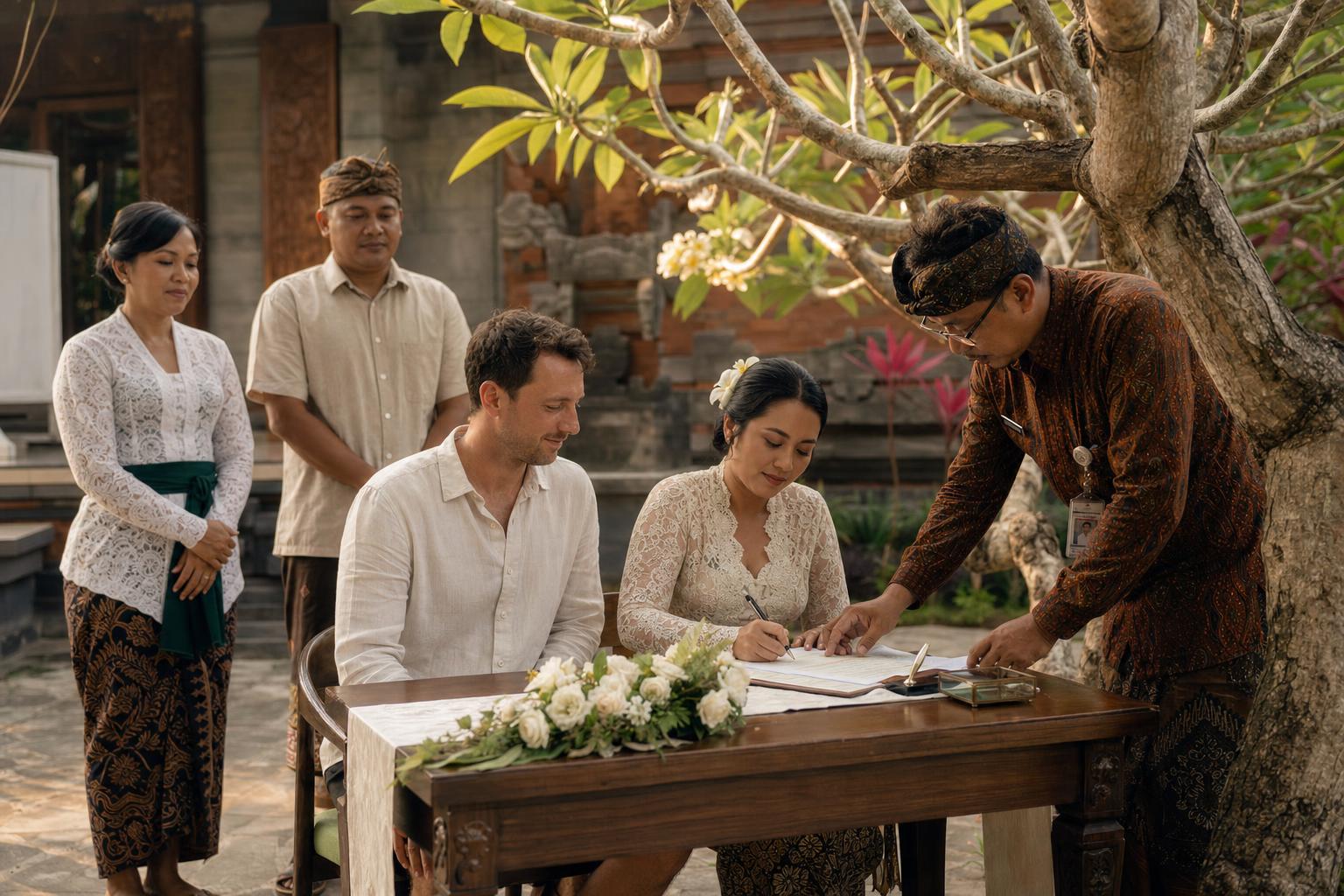
Short answer: yes. Two foreigners can get legally married in Bali, and the marriage is recognised in Indonesia and, with the right stamp, back home too.
Longer answer: Indonesian law attaches conditions that surprise almost everyone, and they decide whether the legal route is realistic for you. I have this conversation with nearly every couple who writes to me, so here is the whole picture, honestly.
What Indonesian law requires
Indonesia has no civil-only marriage. Under the Marriage Law (Law No. 1 of 1974, still the foundation today), a marriage is valid when it is performed according to a religion, then registered with the state. That single fact shapes everything else:
- You both need to declare the same religion, and it has to be one of the six Indonesia recognises: Islam, Protestantism, Catholicism, Hinduism, Buddhism, or Confucianism.
- A religious ceremony comes first. A priest, pastor, imam or pandita marries you according to that faith.
- Then the state registers it. Non-Muslim marriages are registered at the Civil Registry office (Catatan Sipil); Muslim marriages are handled by the Office of Religious Affairs (KUA). Without that registration, the marriage does not legally exist, however beautiful the ceremony was.
Two consequences follow directly. Interfaith marriages are not registered in Indonesia, so a couple of two different faiths cannot marry legally here as they are. And same-sex marriage is not recognised under Indonesian law at all.
If your partner is Indonesian, this shared-religion rule is the first thing to sort out, often before you even propose. I cover how it shapes the whole engagement in how to propose to an Indonesian woman.
If neither of those touches you, and you are comfortable marrying within one of the recognised religions, the legal route is genuinely open.
The paperwork, in plain terms
For two foreigners, the document list looks like this. Your nationality and religion change the details, so treat it as the shape, not the final checklist:
- Passports for both of you, plus your entry stamps or visas (a tourist visa is fine).
- A Certificate of No Impediment (CNI) from each of your embassies or consulates in Indonesia. This is the document that says you are free to marry. Some embassies issue it in Bali, others only in Jakarta, and a few make you start the process at home. It is usually the slowest piece, so we start here.
- Birth certificates, with certified Indonesian translations.
- Divorce decree or death certificate of a former spouse, if either of you was married before, also translated.
- Religious paperwork appropriate to your faith. Catholics have the longest list (a freedom-to-marry letter from your parish, a pre-marriage course, a delegation letter to the church here). For most other faiths it is a letter from your religious community.
- Two witnesses over 18 with passport copies, and a set of couple photos in the format the registry office specifies. Yes, they are particular about the photos.
The religious ceremony and the civil registration usually happen on the same day: the registrar attends, and you sign right after the ceremony. You leave with an Indonesian marriage certificate, the Akta Perkawinan (or the buku nikah for Muslim couples). I wrote a separate guide on getting the Indonesian marriage certificate that walks through each step in order.
Will it count back home?
Almost always, yes. A marriage that is legally valid where it was performed is recognised by most countries, including Australia, the UK, the US, and the EU. If you are marrying an Australian, I go through the specific rules, and the one thing that catches people out, in is a wedding in Bali recognised in Australia.
The practical step is legalisation. Indonesia joined the Apostille Convention in 2022, so for most countries the certificate gets an apostille from the Ministry of Law (the AHU office) and that is it. If your country is not in the convention, the older embassy legalisation chain still works. Check your own country’s rules before you fly home; some ask you to register the foreign marriage locally as well.
How long does it take?
Plan on two to four months of preparation, mostly driven by the CNI and the translations. The in-Bali part is short: documents are lodged with the registry office a couple of weeks ahead, then everything happens on the day.
This is the real difference from a symbolic wedding, which needs no lead time at all beyond the planning itself.
Why most of my couples do it differently
Here is the honest part. Of the international couples I work with, most do not marry legally in Bali. They sign the papers at home, at their local registry office, quietly, sometimes in jeans. Then they come to Bali for the wedding: the ceremony, the vows, the families, the dinner under the frangipani.
The reasons are practical, not romantic:
- The paperwork disappears. No CNI, no translations, no religion declaration. A commitment ceremony needs nothing but the two of you.
- The date is yours. No registry office schedule, no document that expires if your plans shift.
- It changes nothing about the day. Your guests will not know or care where the ink went. The ceremony looks and feels exactly the same.
- It costs less. A managed registration here runs roughly 1,000 to 2,500 USD on top of the wedding. The real cost of a Bali wedding puts that figure next to the other fees, so you can see what you are buying and what you are skipping.
A wedding at home followed by a celebration in Bali is not a lesser wedding. It is the same wedding with the admin done in the easy jurisdiction.
When the legal route in Bali is the right call
It is not rare either. I recommend it when:
- You share a recognised religion and the religious ceremony itself matters to you, for example a Catholic wedding in a chapel here, or a Hindu ceremony.
- Your home country makes civil marriage slow or complicated, and Indonesia is genuinely the simpler path.
- You want the story: married in Bali, on paper, for real. Some couples just do, and that is reason enough.
If that is you, our legal wedding package exists exactly for this. We check your situation against the requirements before you commit to anything, then run the document process alongside the wedding planning so neither one steals from the other.
So, can you?
Yes, legally and truly, if you both share one of Indonesia’s recognised religions and you give the paperwork a few months of runway. If you do not, or you simply cannot face the admin, marry at home and let Bali be the wedding.
Tell me your situation and I will tell you, in one email, which route fits. That first answer costs nothing and usually saves weeks.