How to get an Indonesian marriage certificate
The step-by-step process for foreigners marrying in Bali: the documents, the offices, the religious ceremony, and the apostille that makes it count abroad.
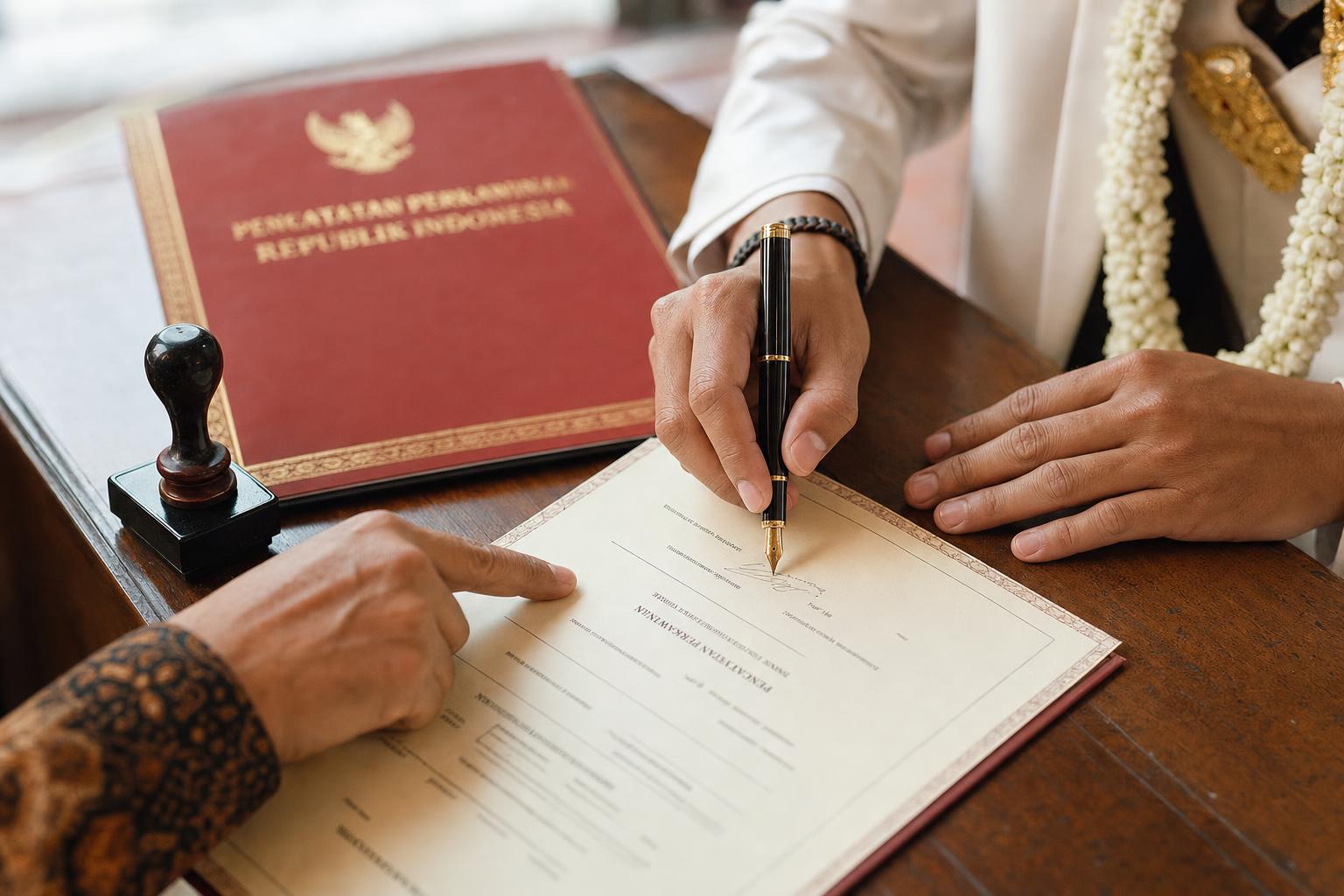
The Indonesian marriage certificate is the document that makes your Bali wedding legally real. For non-Muslim couples it is called the Akta Perkawinan, issued by the Civil Registry office (Catatan Sipil). Muslim couples receive the buku nikah, the marriage book issued by the Office of Religious Affairs (KUA).
I arrange these for couples regularly, and the process is more orderly than its reputation suggests. It rewards starting early and punishes improvising. Here is the whole sequence, in the order it actually happens.
Before you start, one prerequisite decides everything: Indonesia only marries couples who share one of its six recognised religions, through a religious ceremony. If you have not settled that question yet, read can you get married in Bali legally? first. This guide assumes the answer for you is yes.
Step 1: get your Certificate of No Impediment (start here, months out)
The CNI is a letter from your own embassy or consulate stating you are free to marry. Every foreigner needs one, and it is the piece with the longest and least predictable lead time, so it goes first.
Each country does it its own way. Some consulates issue it in Bali in a day. Others only work from Jakarta. A few, and this catches people out, require paperwork that starts in your home country, with your own civil registry, weeks before the consulate will sign anything. Some CNIs also expire after three or six months, so do not collect it a year early either.
Email your embassy in Indonesia before you book anything. Ask three questions: what they need from you, where you must appear in person, and how long their CNI stays valid.
Step 2: gather and translate the rest
While the CNI is in motion, assemble the file. For two foreigners the standard set is:
- Passports and copies, plus your visas or entry stamps (a tourist visa is acceptable)
- Birth certificates
- Divorce decree or former spouse’s death certificate, if either of you was married before
- The religious documents for your ceremony: for a Catholic wedding, your freedom-to-marry letter, pre-marriage course certificate and parish delegation letter; for most other faiths, a letter from your religious community
- Passport copies for two witnesses over 18
- Couple photographs in the registry’s required format, typically 4x6 cm, side by side (they will tell you who stands on which side; they mean it)
Anything not in Indonesian needs a sworn translation. Not a friend who speaks Indonesian, a certified sworn translator. We use translators the registry offices already know, which avoids the round of “translation rejected” that couples doing this alone sometimes hit.
Step 3: lodge the file with the registry
The documents go to the office that will register you: the Catatan Sipil for non-Muslim couples, the KUA for Muslim couples. In practice this happens at least ten working days before the wedding, and we aim for earlier.
The office reviews the file, confirms your ceremony date, and books a registrar to attend. If anything is missing or wrongly translated, this is when it surfaces, which is exactly why the buffer exists.
Step 4: the religious ceremony
On the day, the religious ceremony comes first, because under Indonesian law it is the ceremony that creates the marriage. A priest, pastor, pandita or imam marries you according to your declared faith. It can be in a chapel, a temple compound, or under an arch of flowers on a clifftop lawn; the law cares about the officiant, not the backdrop.
Step 5: the civil registration, usually the same hour
For non-Muslim couples, the civil registrar attends the ceremony or meets you straight afterwards. You and your witnesses sign the register, and the marriage now exists in the eyes of the state. Muslim couples sign with the KUA official, who has usually conducted the ceremony himself.
This is a short, administrative moment, and honestly a lovely one. Most couples are surprised by how much the signing feels like the real thing.
Step 6: collect the certificate
The Akta Perkawinan is typically ready within a few days to two weeks, depending on the office. The buku nikah is often handed over on the day itself. Check every name, date and passport number the moment you receive it. Corrections are far easier before you leave the island than from another hemisphere.
Order a spare official copy while you are at it. Your home country’s registry, a future visa application, or a mortgage lender will eventually ask for one.
Step 7: the apostille, so it works back home
An Indonesian certificate on its own proves nothing to a foreign registry until it is legalised. Since 2022 Indonesia is part of the Apostille Convention, which made this dramatically simpler: the Ministry of Law’s AHU office issues an apostille, a single certificate attached to your document, and that is all most countries need. The application runs through an online system and takes days, not weeks.
If your home country is not in the convention, the older route still exists: legalisation by the Indonesian ministries, then by your country’s embassy. Slower, but well-trodden.
Last step, in your own country: many national registries ask you to record the foreign marriage once you are home. Ask yours what they want alongside the apostilled certificate, usually just a certified translation into your own language.
The realistic timeline
- 3 to 4 months out: contact your embassy about the CNI, start any home-country paperwork it requires
- 2 months out: documents gathered, sworn translations underway
- 2 to 3 weeks out: file lodged with the Catatan Sipil or KUA
- The day: religious ceremony, then the signing
- Days to 2 weeks after: certificate issued
- After that: apostille, then registration at home
None of this is difficult. All of it is sequential, and the early steps gate the later ones, which is why couples who start at three months find it calm and couples who start at three weeks find it impossible.
The paperwork runs on its own track, alongside the wedding rather than instead of it. Planning a Bali wedding: where to start sets out the order for everything else, and what a Bali wedding typically costs covers what to budget around the registration itself.
If you would rather not run this yourself, it is part of our legal wedding package: we check your eligibility first, then manage the file, the translators, the registry and the apostille while you plan the part you will actually remember.