Catholic wedding in Bali: the church and civil steps, in order
A Catholic marriage in Indonesia is two things prepared at once: the Church marriage and the civil registration. Here are the ten steps in order, which ones can overlap, and the one location mistake that leaves couples with no Catholic marriage at all.
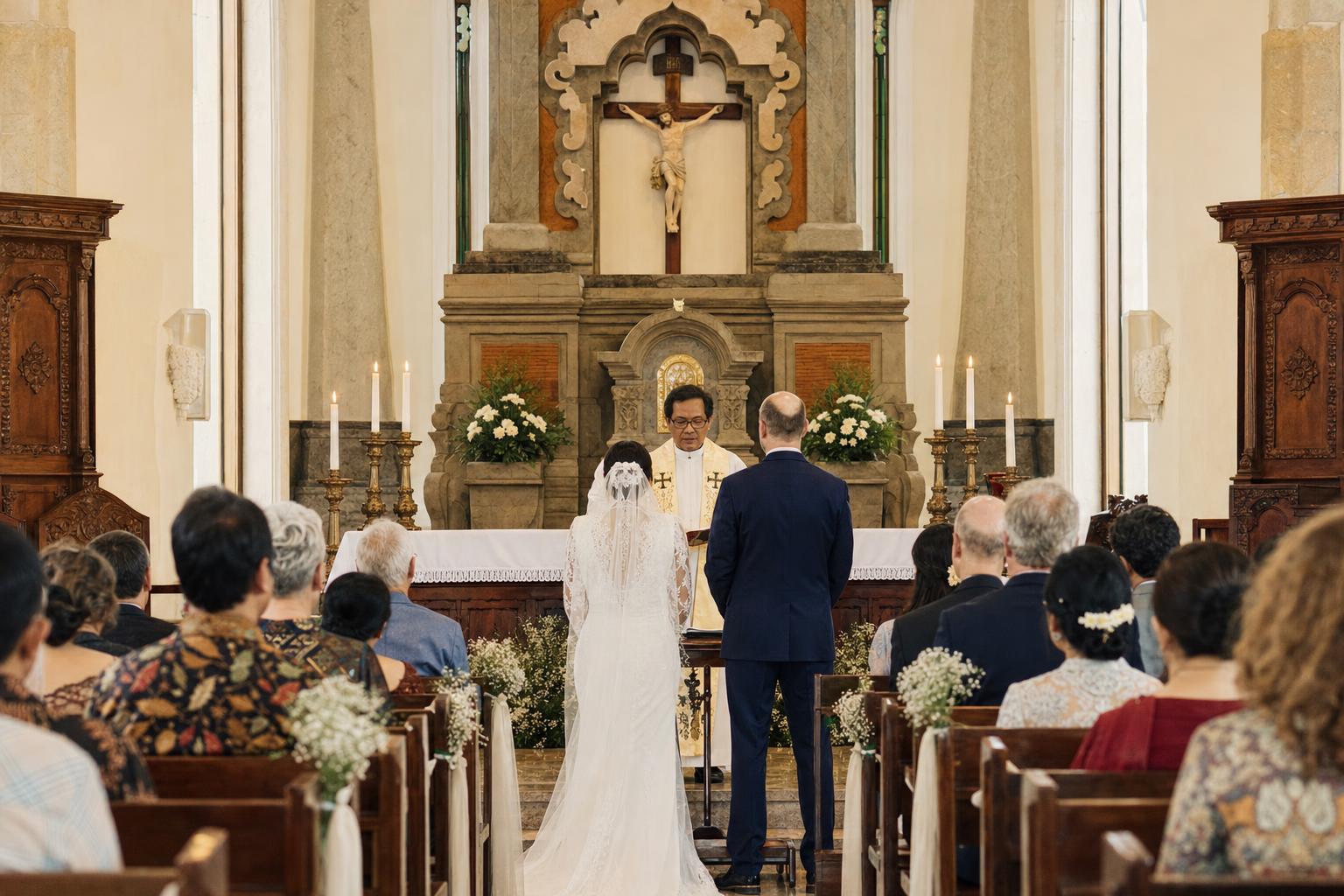
A Catholic wedding in Indonesia is two pieces of work running at the same time. Your parish prepares the Church marriage: the course, the documents, the canonical investigation, the ceremony itself. The civil registry office registers it and issues your marriage certificate. Different offices, different documents, two tracks.
Most of the ten steps below sit on the Church track. Steps 5 and 9 are civil. Some parishes help coordinate with the civil registry, so ask early what they will arrange and what stays with you. The order works whether you are both Indonesian or one of you is from overseas.
If you are still deciding whether to marry legally in Indonesia at all, can you get married in Bali legally? covers the shared-religion rule and the alternative most international couples choose.
I also walked through every step on video:
The two offices you will deal with
The parish handles everything Catholic: your preparation, your Church documents, and the ceremony.
The civil registry is the Dinas Kependudukan dan Pencatatan Sipil, the population and civil registration office, which everyone shortens to Dukcapil. It issues the Akta Perkawinan, your Indonesian marriage certificate.
Neither replaces the other. A Church marriage with no Dukcapil registration is not a legal marriage in Indonesia, and Dukcapil will not register a Catholic marriage without the Church’s marriage document.
Step 1: speak to your parish
Contact the parish office before you collect any documents, because almost everything later depends on what it tells you. Explain where you both live, your nationalities, your preferred date, and where you would like the ceremony to be. If either of you has been married before, say so at this first meeting.
Ask for the written document checklist and the preparation schedule. If you are marrying outside your home parish, ask how the two parishes should coordinate. You do not need every answer before this meeting. Its job is to tell you what applies to you.
Where the ceremony can take place
This is the question I get most about a Catholic wedding in Bali, and the answer surprises people.
A Catholic wedding belongs in a church, at the altar, normally within a Mass. Canon 1118 of the Code of Canon Law makes the parish church the place for a marriage between two Catholics, or between a Catholic and a baptised Christian of another church. Another church or chapel is possible with permission. Anywhere that is not a church, a hotel ballroom, a villa garden, a beach, needs the permission of the local bishop, and in practice that permission is rarely given.
So plan it this way round: the church is the ceremony, and your villa or hotel is the reception.
Be careful with resort chapels in particular. The glass wedding chapels on the Uluwatu cliffs are beautiful, and a symbolic ceremony there is lovely, but a hotel that offers weddings does not mean the Church permits a Catholic marriage there. A ceremony your parish has not authorised is not a Catholic marriage, and it will not produce the Church document Dukcapil needs later. Confirm the location with the parish before you book or pay for anything.
Ask about your date in the same call
A few seasons need a little care.
- Advent, from late November through December, and Lent, roughly February to early April, are both possible. The celebration is kept more modest, with fewer flowers and softer music, and it can be beautiful that way.
- Good Friday and Holy Saturday are the only two days closed completely. Easter moves every year, so ask the parish for the dates in your year.
Good dates go quickly. The earlier you ask, the more choice you have. For weather and crowds, my month-by-month guide to the best time to get married in Bali covers the rest of the decision.
Step 2: prepare your Church documents
Follow the checklist from the parish handling your wedding, not a list found online. It commonly includes:
- A recently issued baptism certificate
- Your birth certificate, and for Indonesian partners the KTP (national identity card) and kartu keluarga (family card)
- A letter of introduction from your local Catholic community, or permission from your home parish if you marry elsewhere
- The registration form, photographs, and witness documents
Ask whether they also need your confirmation record. If you have not been confirmed, tell the priest so he can guide you.
Ask specifically about the Surat Liber, the Church documentation that you are free to marry, and how your parish wants it established. Keep it separate in your head from the SKBM, the civil letter stating you have never been married, which Dukcapil may ask for. The Surat Liber concerns your freedom to marry under Church requirements. The SKBM is a civil marital-status document. One does not replace the other.
Step 2b: the foreign Catholic partner’s Church documents
If your partner is a foreign Catholic, they prepare their Church documents too, and they can start as soon as the Indonesian parish has given you the checklist.
They contact their parish back home for a recently issued baptism certificate and the documentation confirming freedom to marry, which their parish may call something else. Share the Indonesian checklist with both parishes so they know what is needed: how recent the documents must be, whether translations are required, and whether the file needs to pass through the diocesan office.
An embassy letter does not replace this Church check. Start it early. Documents from overseas are usually the slowest part of the file, and step 4 cannot happen until they arrive.
Step 3: the marriage preparation course
Your parish may call it the pre-marriage course. In Indonesia it is the Kursus Persiapan Perkawinan, which everyone calls KPP. You do not need to finish step 2 first: the course and the documents run side by side, which saves a few weeks.
The course covers married life: communication, family responsibilities, and the meaning of Catholic marriage. Ask your parish which course it accepts and when you should attend, and keep the certificate for your file. If you take the course at another parish or overseas, confirm the Indonesian parish accepts it before you enrol.
Then ask the timing question: how long will you accept our certificate, and would we repeat the course if the wedding is postponed? There is no single rule for every parish. Ask the same about the validity of your baptism certificate and canonical paperwork, which is a separate clock. Some parishes want documents issued within the last six months.
Step 4: the canonical investigation
The Church’s formal premarital interview is usually called the canonical investigation, or the prenuptial inquiry. In Indonesia it is the penyelidikan kanonik.
This step has a real dependency: the priest needs your documents from step 2 and your KPP certificate from step 3 before he can hold it. Completing the course does not replace it.
The priest reviews your documents and talks with you about your background, your freedom to marry, and your understanding of Catholic marriage. Be open about any previous marriage or other circumstances. Bring the documents he asks for, usually the baptism certificate, the proof of freedom to marry, and the KPP certificate. Depending on your situation you may also need witnesses who know you well enough to confirm your marital history. If you live overseas, ask both parishes where the investigation should take place and how the completed file reaches the church in Bali.
Two situations to settle before step 4
Both belong in your first conversation with the parish.
A previous marriage. A civil divorce alone does not establish freedom to marry in the Catholic Church. The parish may need further documents or a Church review. Settle this before you confirm a wedding date.
Only one of you is Catholic. Marriage to a baptised Christian who is not Catholic needs permission. Marriage to someone who is not baptised needs a dispensation. The Catholic partner makes commitments about their faith and the Catholic upbringing of their children, and the other partner is informed of them. Your parish explains the process.
The civil side has to be checked separately, because Church approval does not guarantee civil registration. In 2023 Indonesia’s Supreme Court issued a circular (SEMA No. 2 of 2023) directing judges not to grant applications to register marriages between people of different religions. If your situation involves two faiths, talk to the parish, the civil registry, and a qualified Indonesian lawyer before you make any firm booking.
Step 5: prepare your civil paperwork alongside everything else
Your civil documents do not depend on the Church steps, so prepare them while you work through steps 2 to 4. There is no reason to wait until after the ceremony to find out what Dukcapil wants. Only one item has to wait: the Church marriage document, which exists after step 8.
If you marry in Bali but live elsewhere, confirm which Dukcapil office handles the registration and whether you need supporting documents from your home area. For Indonesian partners, the list commonly includes both KTPs and family cards, birth certificates, a photograph of the two of you in the required format, identification for two witnesses, the application form, and the Church marriage document once it is issued. Ask whether the SKBM or other letters are needed, and which divorce or death documents apply if either of you was married before.
Step 5b: the foreign partner’s civil papers
The foreign partner commonly needs a valid passport, a birth certificate, the immigration or residence documents that match their status, civil evidence of being free to marry, and documents for any previous marriage.
That civil evidence is usually called a Certificate of No Impediment, or CNI. Its name and process depend on your nationality, so ask your embassy or consulate how it works, then confirm with Dukcapil what it will accept. Ask also which documents need a sworn Indonesian translation and an apostille or other legalisation, and confirm before paying for any of it, because not every document is treated the same way.
Step 6: the banns and the final Church check
Once the canonical investigation is done, your parish announces your marriage to the congregation. If you grew up Catholic, you know these as the banns, read at Mass. In Indonesia they are the pengumuman perkawinan, usually read on three Sundays, and they give the community a chance to raise any known impediment.
Ask when and where they will be read. If you belong to different parishes, they are usually announced in both.
Before the wedding, confirm with the parish that your file is complete and any permission or dispensation has been granted. Then finalise the readings, music, witnesses, and rehearsal.
Step 7: the sacrament of reconciliation
This step waits for nothing. Arrange it whenever suits you, as long as it is before the ceremony.
Catholic partners are encouraged to receive the sacrament of reconciliation, confession, which in Indonesia is the pengakuan dosa. It does not have to be the day before the wedding. Speak to your priest about a time. A partner who is not Catholic is not expected to take part, and the priest can guide you both in preparing for the ceremony.
Step 8: the wedding ceremony
By now your preparation and any approvals from step 6 are complete. Follow the arrangements you agreed with your priest and parish, including the time and the witnesses.
After the ceremony, ask when your Church marriage document will be ready and who will collect it. It is the last piece of your civil file, and step 9 cannot happen without it. Confirm who is handling the civil registration too. If the church or your planner is helping, know exactly what they are doing and what is still yours.
Step 9: register at Dukcapil within 60 days
Submit the Church marriage document and the civil file from step 5 to the Dukcapil office. Under Indonesia’s civil administration law, a marriage is reported within 60 days of the wedding. Arrange it before the wedding so the deadline does not slip past while you are travelling or on your honeymoon.
When you receive your Akta Perkawinan, check every detail: both names, birth details, the wedding date, and the place. For the Indonesian partner, ask how to update the KTP and kartu keluarga. Some offices arrange that together with the certificate.
Step 10: make the certificate usable abroad
This step only applies if one of you is from overseas, and it starts once you have the Akta Perkawinan in hand. Ask the questions early so you can act the day it arrives.
Ask your embassy, or the authority that will receive the document, whether it needs an apostille. In Indonesia, apostilles are issued by the Directorate General of General Legal Administration (AHU) at the Ministry of Law, which you may still hear called by its former name, Kemenkumham. If your country does not accept apostilles, ask which legalisation route it uses instead.
You may also need a certified or sworn translation into your own language. A machine translation will not do. Check whether the apostille needs translating as well as the certificate, and which translators the receiving authority accepts.
Finally, ask whether you need to report or register the marriage with your embassy or your home civil registry. An apostille does not replace that step. Australian couples will find the specifics in is a wedding in Bali recognised in Australia?, and the general order is in how to get an Indonesian marriage certificate.
When to start
Call your parish 6 to 12 months before your preferred date, especially if documents have to come from overseas. Keep the Church calendar in mind when you choose the date, and let the parish set the schedule for the KPP, the investigation, the banns, and the documents that expire.
The two habits that save the most time: start your civil paperwork early, and start the overseas documents the day you have the parish checklist. If your date changes, tell the parish so it can check what needs updating.
This is a general guide. Your parish, your civil registry office, and your embassy confirm the requirements for your own situation.
If you are planning a Catholic wedding in Bali, tell me your preferred date, a rough guest count, both nationalities, and whether you are both Catholic. Our legal wedding package runs the Dukcapil side alongside the planning, and we build the reception around the ceremony your parish confirms.