Is a wedding in Bali recognised in Australia?
Short answer: only if it was a legal marriage under Indonesian law to begin with. Here is exactly when a Bali wedding counts in Australia, when it does not, and what to do about either case.
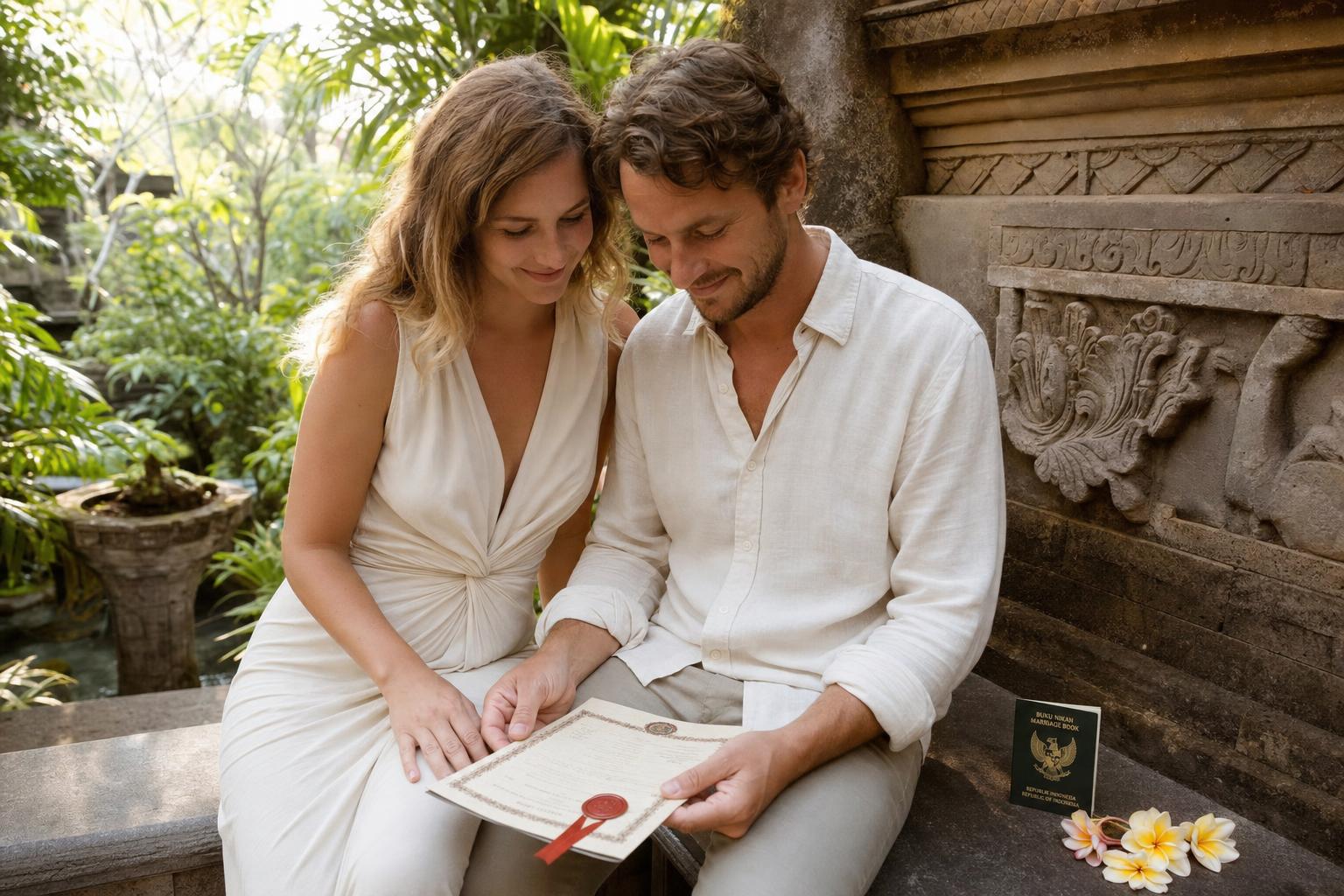
Short answer: yes, if the marriage was legally valid in Indonesia in the first place. No, if it was a symbolic ceremony with no civil registration behind it, which is what most couples who marry in Bali actually have. Australia does not care where you married. It cares whether you were, legally, actually married.
That distinction trips up more Australian couples than anything else in this process, so let’s take it apart properly.
What Australia is actually checking
Australia does not run its own approval process for an overseas wedding. There is no form to lodge, no ceremony to re-register once you land. Under Part VA of the Marriage Act 1961, a marriage performed overseas is recognised in Australia if it was valid under the law of the country where it happened. Lawyers call this the “valid where celebrated” rule. In practice: if Indonesia says you are married, Australia generally agrees, automatically, with no paperwork filed on the Australian side.
The Attorney-General’s Department is explicit that a foreign marriage cannot be registered in Australia. Recognition either exists already, because the marriage met the conditions, or it does not exist at all, because it never legally happened. There is nothing in between to apply for.
Which means the real question is not “does Australia recognise Bali weddings.” It is “was your Bali wedding a legal marriage under Indonesian law.”
The step almost every couple skips
I wrote a separate guide on getting married in Bali legally, so I’ll keep this part short: Indonesia has no civil-only marriage. A wedding becomes legal in two steps, a religious ceremony first, then registration with the state, at the Civil Registry office for most faiths or through the Office of Religious Affairs for Muslim couples, which issues the Buku Nikah. Skip either step and you have a beautiful ceremony with zero legal standing in Indonesia, and therefore nothing for Australia to recognise.
This is not a technicality that catches people out. It is the default. Most international couples we plan for choose a commitment ceremony on purpose: same vows, same rings, same day, no religious declaration, no civil registration, and legally speaking, nothing happened. That is a deliberate choice for most couples, and it is a perfectly good one. It just means there is no marriage for Australia to recognise, because there is no marriage yet at all.
If you did go through the full Indonesian process, with a registered religious ceremony and a Civil Registry or KUA certificate in hand, that is a different situation entirely, and it is the one the rest of this guide covers.
When Australia will say no anyway
A validly registered Indonesian marriage clears the first hurdle, but section 88D of the Marriage Act 1961 still withholds recognition in a short list of cases:
- Either of you was already married to someone else, in a marriage Australia recognises, at the time.
- One of you was under marriageable age. Australia’s is 18, with a narrow court-approved exception for someone aged 16 or 17.
- You are closely related in a way Australia prohibits, such as a parent-child or sibling relationship.
- Real consent was missing, through duress, fraud, a mistake about who you were marrying, or not understanding what the ceremony actually did.
None of that is specific to Indonesia. It is the same short list Australia applies to a marriage from any country. For the overwhelming majority of couples marrying in Bali, none of it is relevant, and a properly registered Indonesian marriage is recognised in Australia exactly as it would be if you had married in Paris or Fiji.
I put together a short video walking through this same ground, if you would rather watch than read:
The paperwork that follows you home
Recognition itself is automatic, but using the certificate in Australia is a separate, practical step, and it trips people up for a different reason: nobody tells them the rules are set by whichever agency they are dealing with, not by one master checklist.
Apostille. Indonesia joined the Apostille Convention in 2022, so a marriage certificate issued there can carry an apostille from the Ministry of Law rather than going through embassy legalisation. An apostille only authenticates the certificate itself, the signature and the stamp. It does not turn a symbolic ceremony into a marriage, and most Australian agencies will not ask for one unless they specifically say so.
Translation. Any document not in English needs an English translation to be used in Australia, and the requirements vary by agency: the Department of Home Affairs wants the translator’s credentials included; Medicare and the Australian Taxation Office have their own document rules for updating a name or enrolling a spouse. None of it is unified, so check the specific agency’s page before you assume last time’s translation will do.
Court, only if disputed. If a marriage’s validity is ever genuinely contested, the Federal Circuit and Family Court of Australia can make a formal declaration. This is rare, and not a step most couples will ever need.
Using it for a partner visa
If an Australian citizen or resident wants to bring their spouse home, the marriage certificate is the Department of Home Affairs’ primary evidence that a legal marriage exists. Its own guidance is direct: provide the marriage certificate, or other evidence the marriage is valid in Australia.
What it does not do is prove the relationship is genuine. Home Affairs separately wants evidence of a real, ongoing life together: shared finances, a shared home, how the people around you see the relationship, that kind of thing, often backed by witness statements on Form 888. A certificate proves you are married. It does not, on its own, prove the marriage is real, and the visa officer will ask for both.
Same-sex couples: the one point that does not move
Indonesia does not perform or recognise same-sex marriage. A same-sex ceremony held in Bali, however it was run, cannot be a legal Indonesian marriage, so there is nothing for section 88C’s “valid where celebrated” test to attach to, and no amount of apostilling changes that.
Australia has recognised valid foreign same-sex marriages since December 2017, including ones performed before that date, provided they were legal where they happened. So the workable order for a same-sex couple is the reverse of what an opposite-sex couple might do: marry first, at home or somewhere that legally performs it, then come to Bali and hold the wedding you actually pictured. The legal step and the celebration simply happen in different places, and neither one is diminished by that.
What we actually tell Australian couples
Most of our Australian couples take the same route regardless of the legal question: sign the papers at home, quietly, at a local registry office, and let Bali be the day everyone remembers. It sidesteps the shared-religion requirement, the Certificate of No Impediment, and months of translated documents, and Australia recognises that marriage without a second thought, because it was legally performed under Australian law in the first place.
If you specifically want the marriage made in Indonesia, on paper, for the story of it, that is genuinely available too. Our legal wedding and registration package walks the Indonesian process alongside the wedding planning, and my guide to getting the Indonesian marriage certificate sets out the document order once you are in it.
This is general information, not legal advice for your specific situation, and the rules around apostilles and agency requirements do shift. Tell me which route you are leaning toward and I will tell you plainly what it actually involves, before you commit to either one.