Buddhist wedding in Bali: the vihara, the pandita, and the paperwork
Who can lead your Buddhist wedding, can it happen at a villa, and how do you get the marriage certificate afterwards? The whole process in three parts, before the day, on the day, and after, with the one question to ask the vihara first.
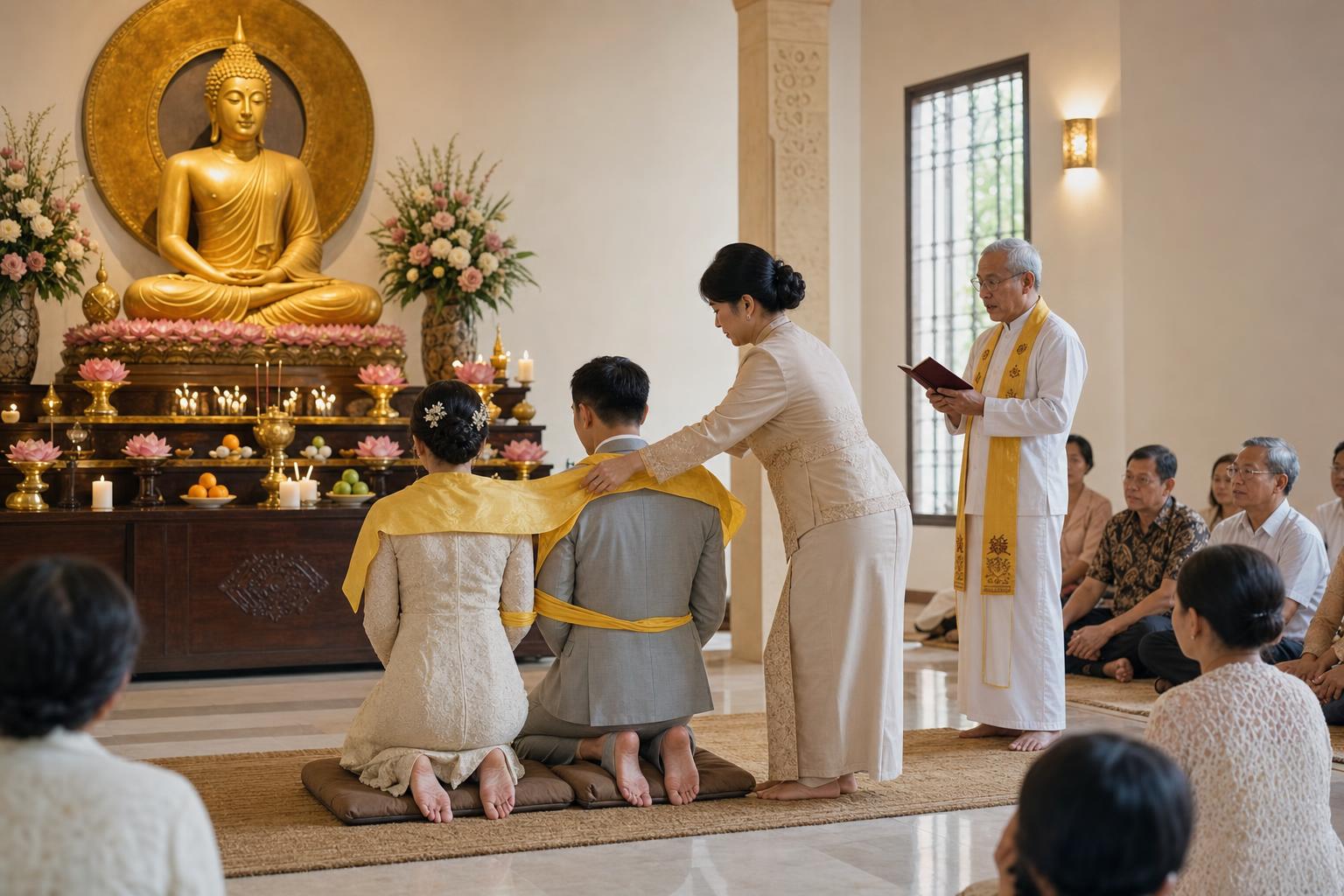
When couples start planning a Buddhist wedding in Bali, the same three questions come up. Who can lead the ceremony? Can it happen at our villa? And how do we get a marriage certificate afterwards?
This guide answers all three, in the order you will meet them: before the wedding, on the day, and after the ceremony. The most important question comes first, and it is one most couples only think to ask when something has already gone wrong: who will lead our ceremony and sign our religious marriage document, and are they authorised to do that?
If you are still deciding whether a legal wedding in Indonesia suits you at all, can you get married in Bali legally? covers the shared-religion rule first.
The video version, if you prefer to watch:
The words you will hear
- Vihara: a Buddhist temple or monastery.
- Bhante: a respectful way to address a Buddhist monk. In Indonesian you will also hear biku or bhiksu.
- Pandita: a Buddhist religious teacher or minister, often a lay person rather than a monk.
- Vivahamanggala: the Buddhist wedding ceremony, also written Vivaha Mangala. In Indonesian, perkawinan agama Buddha.
- Paritta: the Buddhist verses recited during the ceremony.
- Dukcapil: the population and civil registration office, which registers your marriage with the state.
Two documents, two purposes
The first is the religious marriage document, arranged through your vihara and issued by the relevant majelis agama Buddha, the Buddhist religious council. It confirms your Buddhist ceremony took place.
The second is the Akta Perkawinan, the civil marriage certificate issued by Dukcapil. The religious document supports your application for it.
You need both. And Buddhist marriages register through Dukcapil, not through the KUA, the Office of Religious Affairs that handles Muslim marriages.
Before the wedding
There are five things to arrange before the day.
1. The religious requirement
For a Buddhist marriage, both partners need to meet the Buddhist religious requirement. If one of you is not Buddhist, speak with the vihara before making any wedding arrangements.
You may be told about Visudhi, the ceremony of formally becoming a Buddhist lay follower: an upasaka for a man, an upasika for a woman. It involves taking refuge in the Three Jewels, the Buddha, the Dhamma, and the Sangha (Tiga Permata in Indonesian), and undertaking the five Buddhist precepts, the Pancasila Buddhis.
If you go through Visudhi, ask about the certificate that confirms it, and check that the vihara or organisation issuing it is accepted by your pandita and the registration office. An informal letter may not meet their requirements.
For an Indonesian partner, changing the religion recorded on the KTP (identity card) and kartu keluarga (family card) can be a separate Dukcapil process. Ask whether it must be finished before the marriage is registered.
And please take your time. Visudhi is a religious commitment, and nobody should feel they have to change faith for a particular kind of ceremony. If what draws you is the calm of a Buddhist wedding rather than the religion, there is another option near the end of this guide.
2. The vihara and your authorised officiant
When you contact a vihara, ask who will lead the ceremony and sign the religious document. Under the Ministry of Religious Affairs’ current guidance, a Vivahamanggala is led by a Pandita Pemimpin Vivahamanggala, an authorised Buddhist wedding officiant, and that pandita needs to be registered with the Directorate General of Buddhist Community Guidance (Ditjen Bimas Buddha).
Can we invite a bhante? You can ask the vihara about a monk taking part in the chanting, the blessing, or religious guidance. Being a monk does not automatically give someone the authority to sign your marriage document, and the same goes for a visiting monk from overseas.
You may also come across organisations such as the Sangha Agung Indonesia, the Majelis Buddhayana Indonesia, WALUBI, or Permabudhi. Membership of an organisation does not answer the question on its own. You still need the individual officiant’s authorisation confirmed.
So ask the vihara directly: who will lead our Vivahamanggala, who will sign our marriage document, and will that document meet the requirements for civil registration? It is a practical question, and the beginning is the time to ask it. Our Buddhist ceremony starts with exactly that check before we book anyone.
Where the ceremony can take place
Discuss the location at the same time. Bali is mostly Hindu, but it has established Buddhist communities and places of worship, including the Brahmavihara-Arama near Banjar in north Bali and the historic Vihara Dharmayana in Kuta. Their presence does not mean they take wedding bookings, so ask about their requirements and availability.
Could we have it at our villa, or on the beach? Possibly, depending on the majelis, but do not book a private venue assuming the religious ceremony can happen there. The official guidance requires the ceremony to take place before a Buddha altar, and the location and arrangements must follow the relevant majelis rules.
A common and lovely solution: the religious ceremony at the vihara in the morning, then the celebration with your guests at a villa or garden venue afterwards. Tell your planner and the vihara what you are hoping for, so they can confirm what is possible before you book.
3. Buddhist marriage guidance
Before the wedding you will need Buddhist marriage guidance, bimbingan perkawinan agama Buddha. It prepares you for married life and for the religious commitments you are making.
Some programmes run around eight sessions, but that is not a fixed number for every vihara. Ask how many sessions you need, when they run, and what proof of completion you receive. They follow the organiser’s schedule, so arrange them early rather than in the final months. If you live overseas, ask whether part of the preparation can be done remotely or through a vihara at home, and agree that before you make travel plans.
The current guidance also includes a premarital health examination and immunisation. Ask which checks and supporting documents apply to you.
4. Your documents
Collect your documents while you arrange the guidance sessions. Your vihara may want the complete file some months before the ceremony, so confirm its actual deadline.
For Indonesian partners the list commonly includes:
- KTP, kartu keluarga, and birth certificate
- Identity documents for your witnesses
- Your parents’ identity documents, or a death certificate where requested
- Photographs of the couple in the required format
- Local marriage introduction or notification letters
- Divorce documents or a late spouse’s death certificate, if you were married before
- A statement confirming your marital status, such as the SKBM, if requested
Use the checklist from your own vihara and Dukcapil office, because document names and local requirements differ. For the ceremony itself, the Ministry’s guidance expects both partners to attend with their parents or guardians, and with witnesses present. If a parent cannot come, discuss the guardian arrangement with the pandita in advance.
For a foreign partner the list commonly includes a valid passport, a birth certificate, the relevant immigration documents (a KITAS or KITAP, if your status involves one), evidence of being free to marry, usually a Certificate of No Impediment (CNI), and divorce or death documents for any previous marriage. Check which foreign documents need a sworn Indonesian translation, and whether an apostille or consular legalisation is required, before you pay for either. We can organise the checklist and tell you what to request, but some embassy documents and declarations need you to apply in person.
5. Your wedding date
Check the date with the vihara before you confirm any other booking.
Some Buddhist communities and couples see the full moon as an auspicious time to marry. Full and new moon days are also uposatha, Buddhist observance days, so the vihara may already have services and community activities scheduled. A date that feels meaningful to you can be a busy one for the temple. Some viharas only hold weddings on particular days, so ask early.
Check Waisak too, the major Buddhist festival and an Indonesian national holiday, along with the observances around it. Viharas are especially busy then, so do not assume availability. Look up the official date for your year rather than relying on an old calendar.
Your wedding does not have to fall on a full moon to be valid. An ordinary Tuesday is fine, provided the religious and legal requirements are met. The real date depends on the vihara, your pandita, your guidance being complete, and your documents being ready. For weather and season, the best time to get married in Bali covers the rest.
On the day: the Vivahamanggala
The details vary between Buddhist traditions and councils, so your pandita explains the order of your ceremony. It may include:
- Offerings of flowers and fruit placed at the altar, as you pay respect to the Buddha
- Paritta, the recitation of Buddhist verses
- Incense, held as you make your marriage promises of respect, faithfulness, and care for each other
- The yellow ribbon, the pita kuning, tied around the couple’s wrists
- The yellow cloth, the kain kuning, which parents may place around the couple
- Blessing water, sprinkled with wishes for your wellbeing
- Marriage advice, the nasihat perkawinan, from the officiant about your responsibilities and your life together
If you would like to say personal vows, ask beforehand whether they can be included, and where they fit. Make sure the required marriage document is signed as instructed.
Before you leave, confirm two things: when the religious marriage document will be ready and who collects it, and who is handling the Dukcapil registration. If the vihara or your planner is helping, agree exactly what they submit and what stays with you.
After the wedding
Register at Dukcapil within 60 days
Complete your civil registration with Dukcapil, using the religious marriage document and your supporting civil documents. Expect a deadline of 60 days from the wedding date. Confirm which Dukcapil office is responsible, especially if you live somewhere other than where you marry.
Report late and additional procedures may apply: extra forms, or verification of the religious document. It is far easier to arrange all of this before the wedding. You can still enjoy your honeymoon, as long as someone knows what needs submitting, when, and whether you must attend in person.
When you receive your Akta Perkawinan, check both names and their spelling, birth dates and places, and the marriage date and place. Ask for corrections promptly. For the Indonesian partner, ask about updating the marital status on the KTP and kartu keluarga, which some offices do together with the certificate.
Using the certificate overseas
If one of you is from overseas, you may need further steps to use the Akta Perkawinan at home. Ask your embassy, or the authority receiving the certificate, what it requires.
One likely requirement is an apostille, which authenticates a public document’s origin, signature, and seal for use between participating countries. It does not by itself decide whether your marriage is recognised abroad. In Indonesia, apostilles are issued by the Directorate General of General Legal Administration (AHU) at the Ministry of Law, formerly called Kemenkumham. If your country does not use apostilles for this, ask which legalisation route applies.
You may also need a certified or sworn translation, of the certificate and possibly of the apostille. And ask whether you must report or register the marriage at home, because an apostille does not replace that step. How to get an Indonesian marriage certificate sets out the general order. Confirm it all before you leave Indonesia.
If you would prefer a symbolic ceremony
Some couples ask about a Buddhist wedding because they love the atmosphere, even though they are not Buddhist themselves. If that is you, you do not need to make a religious commitment to have a peaceful wedding.
A symbolic ceremony in Bali can have personal vows, flowers, and a setting that feels right for you, and our commitment ceremony is built for exactly that. If you would like a religious or cultural blessing with water or offerings, ask the relevant religious leader what is appropriate and whether it is open to non-Buddhist couples.
Call it what it is. A symbolic ceremony is not a legal Buddhist marriage and does not replace the civil marriage requirements. Complete the legal marriage separately in a country where you are eligible, then celebrate here.
When to start
Contact the vihara around 6 months to a year before your preferred date. Allow longer if you live overseas, need foreign documents, or are considering Visudhi. The vihara’s guidance schedule and the registration office’s document requirements set how much time you actually need, and once those are clear, the venue, travel, and celebration fall into place. If your date changes, tell the vihara and your pandita early.
This is a general guide. Your vihara, your pandita, your Dukcapil office, and your embassy confirm the requirements for your own situation.
If you are planning a Buddhist wedding in Bali, tell me your preferred date, a rough guest count, both nationalities, and whether you picture a vihara ceremony or a private celebration afterwards. We will tell you where to start and what to check, beginning with that first question about the officiant.