Getting married in Bali: the documents you need, by nationality
Every foreign couple marrying legally in Bali files the same core papers, plus one document from home that changes with your passport. Here is the full list, how registration works, and what twelve countries ask of you.
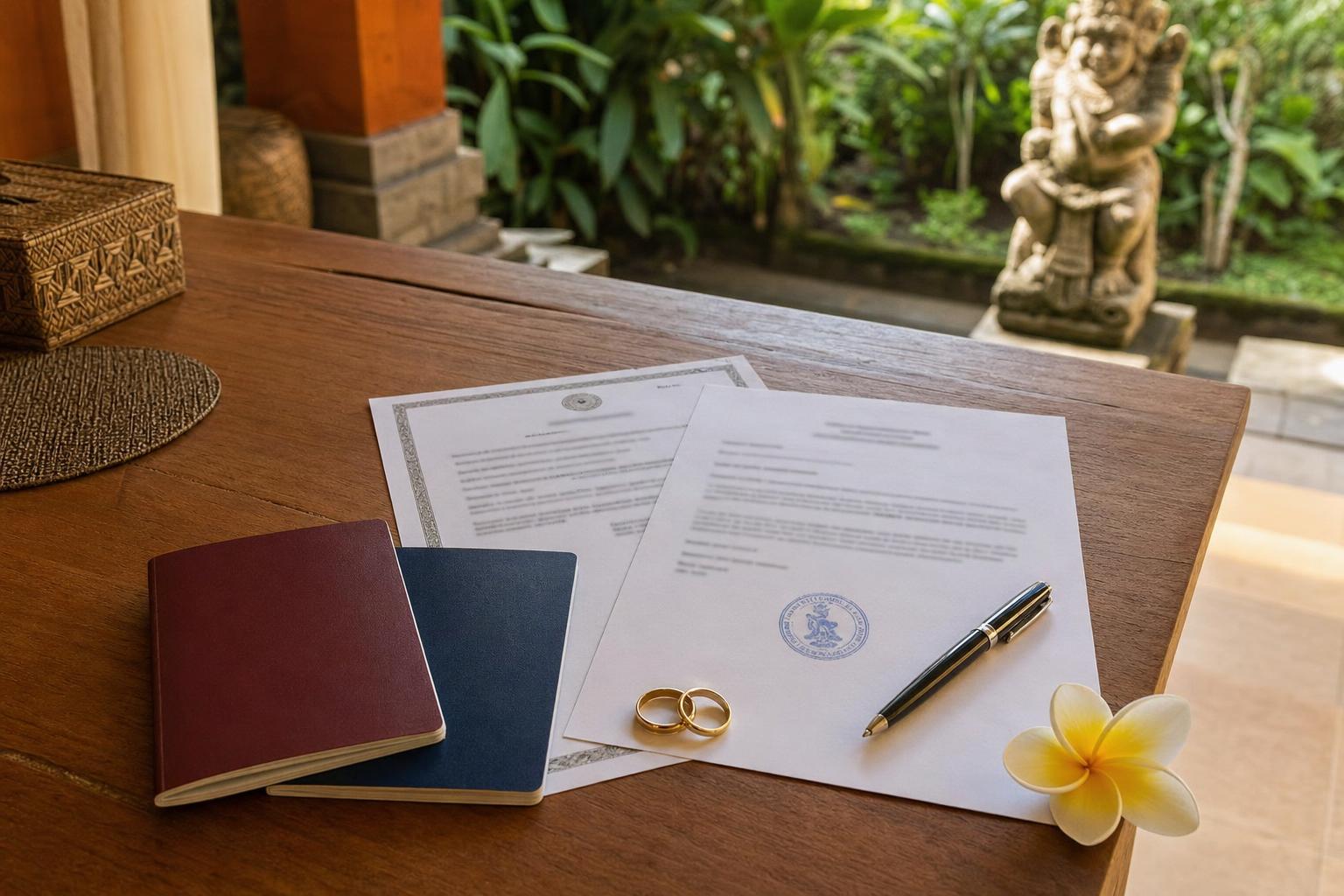
To marry legally in Bali, each of you needs a valid passport, a full birth certificate, proof from your own country that you are free to marry, and the paperwork of the religion you marry in. If either of you was married before, add the divorce decree or death certificate. Then come two witnesses, a set of couple photos, and a religious ceremony that the state registers.
Almost all of that is the same for every couple. One document is not: the proof that you are free to marry. Its name, the office that issues it and the time it takes all depend on your passport, and it sets the pace for everything else.
So this guide gives you the shared file first, then goes country by country: Australia, the United Kingdom, the United States, Canada, New Zealand, Singapore, Malaysia, India, the Netherlands, Germany, France and Italy.
One condition sits underneath all of it. Indonesia only registers a marriage between two people who share one of its six recognised religions. If that question is still open for you, read can you get married in Bali legally? first.
How a legal marriage is registered in Bali
Indonesia has no civil-only wedding. The religious ceremony creates the marriage, and the state then records it. Which office does the recording depends on your faith.
- Protestant, Catholic, Hindu, Buddhist and Confucian couples are registered by the Dinas Kependudukan dan Pencatatan Sipil, shortened to Dukcapil and still widely called the Catatan Sipil. It issues the Akta Perkawinan, your marriage certificate. The office is the one for the regency where the ceremony happens: Badung for Uluwatu, Jimbaran, Seminyak and Canggu, Gianyar for Ubud, Denpasar for Sanur.
- Muslim couples go through the KUA, the Office of Religious Affairs of the sub-district where the akad takes place. Its official conducts and records the marriage and issues the buku nikah.
You lodge the file at least 10 working days before the wedding. On the day, the officiant marries you, the registrar attends or meets you straight after, and you and your witnesses sign. Indonesian civil administration law allows 60 days to report a marriage, but in Bali the registration normally happens within the hour.
The state side costs very little. Dukcapil charges nothing, because Law No. 24 of 2013 makes civil registration documents free. The KUA charges nothing for an akad at its office during working hours, and Rp 600,000, about 33 USD, when its official comes to your venue or marries you outside office hours.
Every step in order, from lodging the file to collecting the certificate, is in how to get an Indonesian marriage certificate.
The core file every couple needs
This combines what the Dukcapil office in Denpasar publishes for foreigners with what the KUA regulation asks. Your officiant and your registry office may add to it, and their list beats any list online, this one included.
- Your passport, plus a copy, with the visa or entry stamp you came in on. A tourist visa is fine. If you live in Indonesia on a KITAS, bring your residence documents too.
- Your free-to-marry document, in the original. Most countries call it a Certificate of No Impediment, or CNI. Several issue something else under another name, which is what the country sections below are for.
- Your full birth certificate, the version with your parents’ names on it.
- Proof that any earlier marriage ended: the final divorce decree, or your late spouse’s death certificate.
- The religious paperwork for your faith. After the ceremony the officiant issues a letter confirming the marriage took place, and that letter is what the registrar records. Catholics have the longest list before the day, set out in my Catholic wedding guide. Muslim couples follow their own sequence at the KUA, from the letters from home to the marriage guidance course, covered in the Muslim wedding guide.
- Colour photos of the two of you side by side, 4x6 cm. Bring at least four.
- Two adult witnesses with a passport or ID card. For a Muslim akad, both witnesses must be Muslim men.
For a foreign partner, the KUA also asks for the details of both your parents.
Translations and the apostille: what changed in 2022
Indonesia joined the Apostille Convention on 4 June 2022, and that removed the slowest part of the old process. A document from another member country now needs an apostille from its own country, in place of legalisation by the Indonesian embassy there. Eleven of the twelve countries below are members. Malaysia is the exception.
Which of your documents need the apostille is decided by the office receiving them. The KUA regulation says it plainly: for a country that uses apostilles, the free-to-marry document comes with a copy of its apostille certificate. The Italian embassy goes further and warns its citizens that the Indonesian authorities only accept town hall certificates apostilled by the prefecture. Ask your registry office before you pay for anything, and order your full birth certificate early, because an apostille adds days or weeks at home.
Everything not in Indonesian then needs a translation by a penerjemah tersumpah, a sworn translator. A friend who speaks Indonesian does not count, and neither does a machine. The KUA regulation exempts documents in Malay. A few embassy documents already come in Indonesian, which saves a translation: the American affidavit, the New Zealand consular letter and the Italian nulla osta among them.
Going home, the Indonesian certificate gets its own apostille if your country’s authorities ask for one. It comes from the AHU directorate of the Ministry of Law. You apply online, the ministry verifies within three working days of a complete file, and the fee is Rp 200,000 per document, about 11 USD. Some embassy websites still describe the older route through the Indonesian foreign ministry. Since June 2022 the apostille replaces it for every member country.
The twelve countries at a glance
| Nationality | Document | Who issues it, and what to know |
|---|---|---|
| Australia | CNI | Consulate, Bali. A$181, usually issued while you wait. Registries want it under three months old. |
| United Kingdom | Affirmation | Jakarta or Bali. £50, apply online, then attend in person. Valid three months. |
| United States | Affidavit | Consular officer. USD 50, sworn in person, ready the same day. |
| Canada | Statement letter | Embassy, Jakarta. CAD 30. Canada warns some countries do not accept it, so ask the registry first. |
| New Zealand | CONI and letter | Wellington, then Bali. NZ$180 plus postage, three to five weeks, then Rp 820,000 for the consular letter. |
| Singapore | No CNI issued | Ask the embassy. No official guidance for Indonesia. Email the embassy in Jakarta. |
| Malaysia | JPN status letter | JPN, then embassy. RM5, valid six months. Muslims also need state religious permission. |
| India | Single status, NOC | India, then Bali. Court or magistrate certificate apostilled in India. Guidance written for marriages to Indonesians. |
| Netherlands | Verklaring | Embassy or town hall. €30 at the embassy, about 10 working days. Some must apply to their Dutch municipality. |
| Germany | EFZ and certificate | Standesamt, then embassy. Ehefähigkeitszeugnis valid six months. Embassy certificate €35, three to five working days. |
| France | CCAM | Embassy, Jakarta. By post. Banns for 10 days, at least three months to issue. |
| Italy | Nulla osta | Embassy, Jakarta. About Rp 100,000, two to five working days, plus apostilled town hall certificates. |
Fees and timings as published by each embassy or government in 2025 and 2026. They change, so check them when you book.
Country by country
If the two of you hold different passports, each of you follows your own country’s section, and the slower one sets your timeline.
Australia
Australians apply for a Certificate of No Impediment to Marriage at an Australian mission in Indonesia. In Bali that is the Consulate-General in Denpasar, which covers Bali and both Nusa Tenggara provinces, Lombok included. The embassy notes that the registry office or KUA normally wants the CNI from the mission responsible for the area where you marry, so the Bali consulate is the one to use.
Book an appointment online, bring your passport, your partner’s passport and any divorce or death certificate, and sign in front of the consular officer. The fee is A$181, or Rp 2,232,000 on the consulate’s June 2026 fee table, and the certificate is usually issued while you wait. It carries no expiry date, but the embassy warns that registry offices do not normally accept a CNI issued more than three months earlier, so book inside that window.
Back home there is nothing to register: Australia cannot register an overseas marriage, and one legally performed in Indonesia is recognised automatically. Smartraveller does warn that an overseas certificate may not be accepted as proof of a name change, so ask your state registry of births, deaths and marriages before you rely on it. The full recognition rules are in is a wedding in Bali recognised in Australia?
United Kingdom
The UK does not issue a CNI for Indonesia. It issues a marital status affirmation, a declaration that you are free to marry, certified by the embassy. Sworn with a religious oath, the same document is called an affidavit.
Apply and pay online (£50, not refundable), then book an appointment at the British Embassy in Jakarta or the British Consulate in Bali and make the declaration in person. Bring your passport, your full birth certificate with your parents’ details, proof of your permanent address dated within three months, your partner’s passport and proof of address, proof that any earlier marriage ended, and proof of any previous name change. If you are both British, each of you applies.
You leave the appointment with the document in hand. The FCDO treats it as valid for three months, so time the appointment for the last three months before the wedding.
Back home there is no way to register an overseas marriage in the UK, and no need to. It is recognised if it was lawful in Indonesia and would be allowed under UK law, and the UK does not require foreign documents to be legalised. You may still want an English translation of the certificate.
United States
The US embassy calls it a Certificate of No Impediment to Marriage, though the form itself is an Affidavit of Eligibility for Marriage, a sworn statement in English and Indonesian. No American authority issues a certificate of eligibility to marry, so a statement sworn before a consular officer stands in for one.
Book a notary appointment, bring your passport and any proof that earlier marriages ended, and pay USD 50, in rupiah cash or by card. You sign in front of the officer and the document is ready the same day. The embassy’s marriage page tells you to come to the embassy in Jakarta, while its notarial page lists appointments in Jakarta, Surabaya and at the consular agency in Jimbaran, Bali. Ask the Bali office whether it handles this affidavit before you book a flight to Jakarta.
Back home there is no federal registration. The US generally recognises marriages legally registered in Indonesia, marriage records are a state matter, and the federal government keeps no record of marriages abroad. The embassy advises getting extra official copies of your certificate, which I would do before you leave the island.
Canada
Canada does not issue certificates of non-impediment. The embassy in Jakarta issues a Statement Letter in lieu of Non-Impediment to Marriage Abroad instead, which says exactly that.
You have to be in Indonesia to apply. The file holds both passports, your birth or citizenship certificate, any divorce or death certificate, and a statutory declaration that the embassy asks you to sign in front of a consular officer, by appointment. You can also apply by registered mail with a certified copy of your Indonesian visa or stay permit; ask how the declaration is witnessed in that case. The fee is CAD 30, and documents not in English or French need a sworn translation into one of them.
Two cautions. There is no Canadian government office in Bali: the Australian consulate there assists Canadians under a consular sharing agreement, but nothing official says it can produce this letter. And Canada itself warns that some foreign governments do not accept the statement as proof that you are free to marry. Ask the registry office that will register you whether it takes it, before anything else.
Back home, Canada says marriages legally performed abroad are usually valid, and there is nothing to register.
New Zealand
New Zealanders need two documents. The Certificate of No Impediment (CONI) comes only from Births, Deaths and Marriages in Wellington, and the Indonesian registry also wants a consular letter, in English and Indonesian, confirming its details.
Apply for the CONI on form BDM189, by post or courier, with a copy of your passport and any divorce or death certificate. BDM contacts a parent, relative or friend to confirm they know of no impediment, holds the certificate for 14 days as the law requires, and takes three to five weeks overall. The base fee is NZ$180, plus postage.
Then send or bring the original CONI and a passport copy to the embassy in Jakarta or the New Zealand consulate in Bali for the consular letter, which costs Rp 820,000 plus a courier fee. The embassy says the CONI needs neither an apostille nor an Indonesian translation for this letter.
Back home there is no obligation to register. New Zealand acknowledges an Indonesian marriage certificate once the marriage is registered under Indonesian law.
Singapore
I have to be plain here: I found no official Singapore guidance for marrying in Indonesia. The Registry of Marriages does not issue a CNI. In other countries, Singapore’s embassies point couples to two substitutes: an official search of the marriage records, and a statutory declaration of your marital status made in person at the embassy. Whether a registry office in Bali accepts either is not published anywhere.
So email the Singapore Embassy in Jakarta before you plan around anything, and put the same question to the registry office. Singapore has no consulate in Bali.
Back home there is nothing to do. Singapore recognises marriages validly registered under the law of the country where they took place, and does not ask you to re-register a foreign marriage.
Malaysia
Malaysia’s official checklist for Indonesia is written for Malaysians marrying Indonesians, so treat what follows as the closest guide and confirm it with the embassy in Jakarta.
Non-Muslim Malaysians start with a letter verifying their marital status for use abroad, the Surat Pengesahan Taraf Perkahwinan, from the National Registration Department (JPN), against a statutory declaration. It costs RM5 and is valid for six months. The embassy then issues a support letter for the marriage, and you have to apply in person. Muslim Malaysians also need written permission to marry abroad from a state Islamic religious office.
Back home, registration is compulsory. Non-Muslim couples re-register the marriage with JPN, or at a Malaysian mission abroad, within six months of the wedding, with a penalty for registering late. Muslim couples register with their state religious authority; in the Federal Territories that means within six months of the nikah.
Malaysia is not in the Apostille Convention, so the Indonesian certificate goes through legalisation instead: the Indonesian embassy in Malaysia, then Wisma Putra, Malaysia’s foreign ministry. One small saving on the way in: the KUA does not ask for translations of documents in Malay.
India
India’s official guidance is also written for Indians marrying Indonesians, and it runs in two steps. In India, you obtain a certificate of single status: a declaratory order from the court for your area, or an affidavit notarised by a sub-divisional magistrate, counter-attested by your state’s Home Department and then apostilled by the Ministry of External Affairs. In Bali, the Consulate General of India turns it into a no-objection certificate for the marriage, the same day, on affidavits from both of you in the consulate’s format and a photo each. It may also ask for a sworn affidavit from your parents confirming you are single and that they do not object to the marriage.
After the wedding, the consulate tells Indian nationals to register the marriage with the Registrar of Marriages in India, and to add the spouse’s name to the passport. Its pages still describe attestation of Indonesian documents by Indonesia’s foreign ministry. Both countries are in the Apostille Convention, so ask the consulate which form it now accepts.
For two Indian citizens marrying each other in Bali, I found no official guidance at all, so ask the consulate directly. Most Indian families we plan for register the marriage in India and hold the Hindu ceremony here, which keeps the paperwork where it moves fastest.
Netherlands
The document is the verklaring van huwelijksbevoegdheid, a declaration of capacity to marry, and who issues it depends on where you have lived. If you have never lived in the Netherlands, apply by email to the embassy in Jakarta: €30, about 10 working days after payment. If you live there or used to, apply to your municipality, or your last one. The Hague’s version costs €31.10, arrives by post in three to six weeks, and is valid for six months.
The Dutch government also asks for official proof that you are unmarried, which cannot be your own statement or a notary’s document. The declaration comes on a multilingual form in Dutch, English, French and German, so plan an Indonesian sworn translation. And check that every name on every document matches your passport exactly. The Dutch government’s page is blunt about it: documents with different names are not valid.
Back home, the Netherlands recognises a marriage made in Indonesia, with a certificate apostilled by the Indonesian Ministry of Law. If you live in the Netherlands, registering it with your municipality is compulsory and free. If you live abroad, converting it into a Dutch deed in The Hague is optional. The translation into Dutch, English, French or German must come from a sworn translator.
Germany
Germany works in two steps, one at home and one in Indonesia. First the Ehefähigkeitszeugnis, the certificate of capacity to marry, from the registry office (Standesamt) of your current or last German residence, or Standesamt I in Berlin if you have never lived in Germany. It is valid for six months from the date of issue.
Then the embassy in Jakarta issues a consular certificate for the Indonesian authorities, stating that there is no impediment. It costs €35 and usually takes three to five working days. Without the original Ehefähigkeitszeugnis the embassy issues nothing, and it says there are no exceptions. Someone you authorise can submit the application on your behalf.
The embassy strongly advises bringing the Ehefähigkeitszeugnis with you to Indonesia, requires at least one of you to be present to prepare the wedding, and tells tourists to allow about four weeks to settle everything.
Two points for afterwards. You cannot choose a married name at an Indonesian wedding, so you make a name declaration later, both of you in person, at the embassy in Jakarta or the honorary consul’s office in Sanur. And recording the marriage in the German register is optional, on request, with the Indonesian certificate apostilled and translated into German. If that falls to Standesamt I in Berlin, it currently quotes at least three years.
France
French nationals need a certificat de capacité à mariage (CCAM) from the consular section of the embassy in Jakarta. You send the file by registered post, with no visit needed, including a letter in French on how you met. The embassy interviews the couple only if it thinks it necessary.
The banns are displayed for 10 days, at the embassy and at the consulate or town hall where one of you lives, and the CCAM takes at least three months to issue. It is valid for a year for France, while its validity for the Indonesian side varies between offices. The French partner’s full birth certificate must be under three months old when you file. A foreign partner’s must be under six months old, with a sworn translation and an apostille or legalisation. The honorary consul in Bali does not handle any of this.
Back home, the marriage is transcribed into the French civil register through the embassy in Jakarta, by post again, with the Indonesian certificate apostilled by the Ministry of Law and translated by a translator the embassy recognises. It takes at least three months, and it matters: under article 171-5 of the Civil Code, the transcription is what makes the marriage enforceable against third parties in France. It also gives you your livret de famille.
With France, start early. The CCAM alone takes three months.
Italy
Italians need a nulla osta, which the embassy in Jakarta issues in Indonesian on the basis of a self-certification signed by the Italian partner and a copy of an ID document. It costs about Rp 100,000 and takes two to five working days. The embassy also asks for two certificates from your comune: a birth certificate in the international format, and a combined certificate of citizenship, residence and free civil status from your last comune of residence.
The detail that catches people is in the embassy’s own note. The Indonesian authorities only accept certificates issued by the Italian comune and apostilled by the competent prefecture in Italy, then translated into Indonesian. The self-certification covers the embassy. Bali wants the apostilled originals.
Deliver or post everything to Jakarta. The honorary consul in Bali can forward documents to the embassy and hand over the ones it has issued.
Back home, a marriage celebrated abroad has to be transcribed at your comune to have legal value in Italy. You file through the embassy with the apostilled Akta Perkawinan or buku nikah. The embassy does not accept certificates from a priest or a church, so the civil registration in Bali is the record that counts.
When to start, and how long each document lasts
Two clocks run at once: how long your document takes to obtain, and how long the registry will accept it once you have it. Collect it too late and the wedding waits. Collect it too early and it expires.
The slowest are France’s CCAM, at least three months with 10 days of banns along the way, and New Zealand’s CONI, three to five weeks from Wellington before the consular letter can even start. Anything that begins at a court or registry at home is slow too, as in India and Germany. A Catholic wedding needs 6 to 12 months of lead time with the parish, whatever your nationality.
The shortest-lived are the Australian CNI and the British affirmation, both treated as good for three months. The German Ehefähigkeitszeugnis, the Malaysian JPN letter and the Dutch declaration from The Hague last six months.
For most nationalities, three to four months of preparation is enough. For France, and for anything that has to come from a court or a registry at home, give it five to six months. Either way, book the embassy or consulate appointment late enough that the document is still valid on your wedding day, and lodge the full file with the registry well before the 10-working-day minimum.
What the paperwork costs
The Indonesian side is close to free: nothing at Dukcapil, nothing at the KUA office, Rp 600,000 when the KUA official comes to your venue, and Rp 200,000 per apostille on the way home. Your own country’s document costs anything from about Rp 100,000 for an Italian nulla osta to NZ$180 plus Rp 820,000 for the New Zealand pair. Sworn translations are priced per document, and the religious ceremony has its own costs.
Our legal wedding registration service runs 700 to 1,500 USD for managing the process and coordinating with the registry. With embassy fees, translations and the religious ceremony on top, most couples land between 1,000 and 2,500 USD above the wedding itself.
When the paperwork tells you to sign at home
Some of the routes above are short: an Australian with a CNI from Denpasar is ready in an afternoon. Others run through a court in India, three months of waiting on Jakarta, or a letter your registry may not accept. That is useful information before you commit to anything.
Most of the international couples I work with sign the legal papers at home and hold a commitment ceremony here, with the same vows, the same guests and none of the documents above. Same-sex couples, and couples of two different faiths, cannot register a marriage in Indonesia at all, so for them a ceremony here is always symbolic.
Questions couples ask
Can we marry legally in Bali on a tourist visa?
Yes. The Denpasar registry lists a visit visa among the documents it accepts from foreigners, and none of the embassy pages above ask you to live in Indonesia. Canada and Germany do want you in the country while you apply: Canada for the statement letter, Germany for at least one of you while the wedding is prepared.
Can someone else collect our documents for us?
Usually not. The British, American and Australian documents are signed in person in front of a consular officer, and Malaysia’s support letter needs you there too. Germany allows someone you authorise to submit the consular certificate application, France and Italy work by post, and the Dutch embassy by email. We can tell you exactly what to ask for and when, but your embassy only deals with you.
Tell me both nationalities, your faith and your preferred date, and I will tell you which documents you need, in which order, and whether the legal route here makes sense for you at all.