How a Balinese Hindu wedding works, from pawiwahan to certificate
A Balinese Hindu wedding involves the couple, both families, a priest, and the village, then a civil registration afterwards. Here is the whole process in order, with every Balinese term explained, and the honest alternative if you do not share the faith.
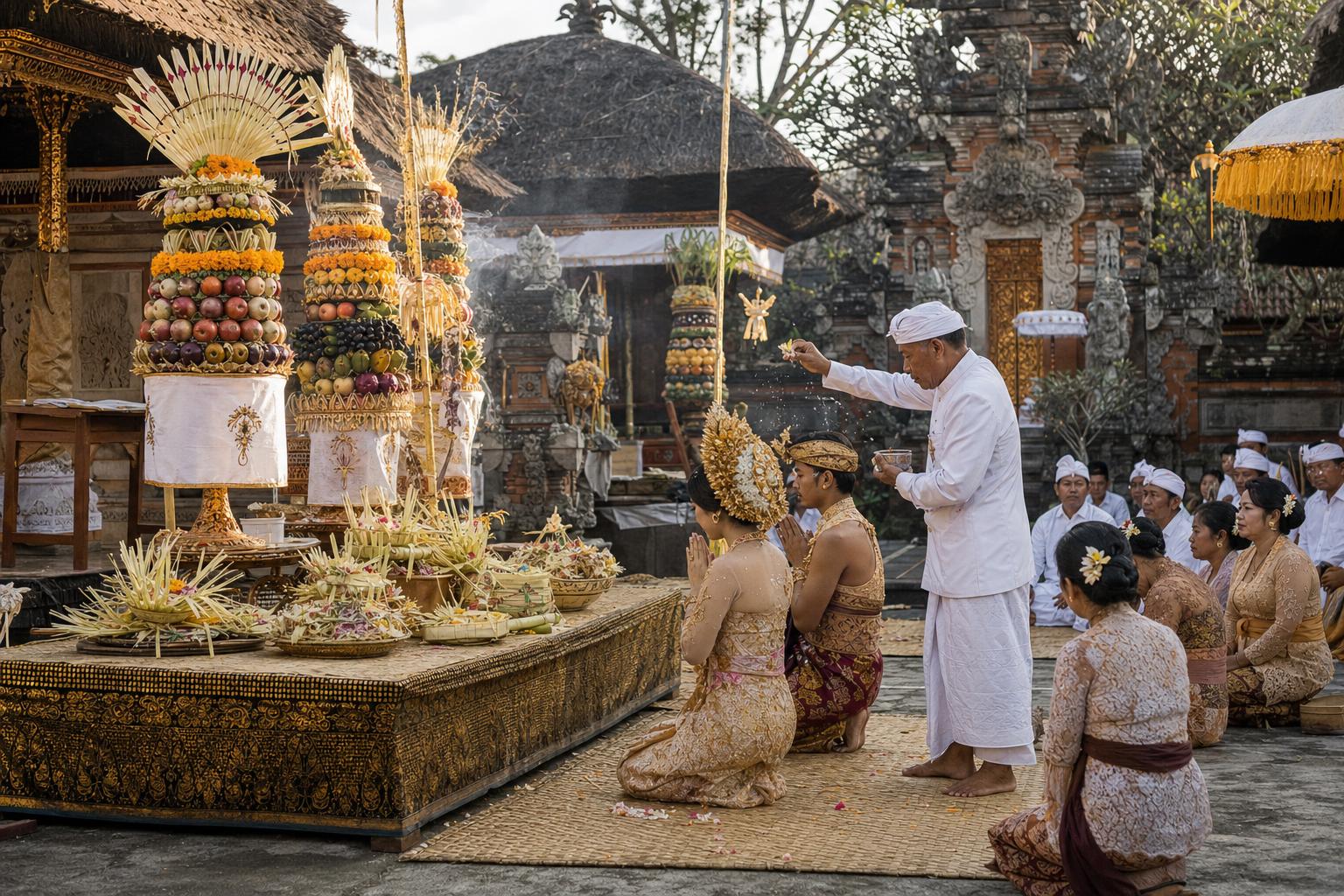
A Balinese Hindu wedding, the pawiwahan, is never just the two of you and a priest. It involves both families, the priest, and the local community, the banjar. Then there is a civil registration to complete afterwards. This guide goes through it in order, from the first family conversation to the certificate in your hand, with the Balinese terms you will hear along the way.
Two notes before we start. This is about the Balinese Hindu tradition, Agama Hindu Dharma. Indian Hindu weddings follow different rituals entirely, and if that is the ceremony you are planning, our Indian Hindu ceremony page is the better starting point. And customs vary between Balinese villages and families, so your priest and family elders confirm what applies to you.
I made a video of the same process, if you would rather watch first:
Step 1: the religious requirement
For the Balinese Hindu marriage route, both partners need to be Hindu. Being a foreign national does not remove that requirement.
If one of you is not Hindu, talk it through with your partner, the family, and a religious leader before you plan any ceremony. Someone who chooses to become Hindu goes through Sudhi Wadani, the ceremony of formally entering the Hindu faith. It happens before the wedding and is a religious commitment in its own right. Ask your priest or the local office of the PHDI, Parisada Hindu Dharma Indonesia, the Indonesian Hindu council, who can conduct it, what preparation it needs, and how you receive the certificate that confirms it.
For an Indonesian partner changing religion, updating the religion recorded on the KTP (identity card) and kartu keluarga (family card) is a separate Dukcapil process. Ask whether it must be finished before the marriage is registered or can run alongside.
Please take your time with this. Nobody should feel they have to change religion to have a Balinese wedding. If you love the ceremony but do not share the faith, the symbolic route near the end of this guide may be the one for you.
Step 2: your families, the banjar, and the desa adat
Start with both families. They know the family tradition, who needs to be involved, and which village arrangements apply.
You will hear a few local terms here:
- Banjar: the local community group. Its head is the kelian banjar.
- Desa adat: the customary village. Its officials are the prajuru, and its leader is the bendesa adat.
- Awig-awig: the customary village rules, sometimes supplemented by pararem. They guide the customary side of the marriage, alongside the religious requirements and national law.
There is no single wedding procedure used by every village in Bali. Ask your family and village officials what you need to arrange, rather than assuming your wedding will look like another couple’s.
The family proposal
The formal proposal is commonly called memadik, and in some places you will hear ngidih. In Indonesian it is the lamaran or meminang. In a common arrangement, the groom’s family visits the bride’s family to ask for her hand, and the two families agree on the ceremony, the responsibilities, and the practical arrangements. The groom’s family often hosts, though that depends on the form of marriage and the families’ custom. If one of you is not Balinese, how to propose to an Indonesian woman covers the family side of asking.
You may also hear ngerorod, often translated as kawin lari, a customary elopement. It is a different customary process, with its own family notifications and obligations still to settle afterwards, and it does not remove either partner’s free consent or any legal requirement.
A small clarification while we are here: when a wedding planner advertises an “elopement” in Bali, they mean a small wedding for two, which has nothing to do with ngerorod.
Step 3: your priest, and the three witnesses
Ask your family which priest should lead the wedding. You may hear of:
- Pemangku: a temple priest
- Sulinggih: a consecrated Hindu high priest
- Pedanda: a Brahmin high priest
The choice depends on the family’s tradition and what the ceremony requires. It is not about a bigger or smaller wedding. Confirm the priest’s availability early, and ask who will provide the religious marriage document you need for the civil registration in step 9.
A central idea in the pawiwahan is the Tri Upasaksi, the three witnesses. They are not three people you book:
- Dewa Saksi, the divine witness, expressed through prayers and rites before God
- Manusa Saksi, the human witness: your family and the community representatives who see the marriage happen
- Bhuta Saksi, the witness of the natural and unseen forces, expressed through offerings and purification rites
You will also hear about the offerings themselves. Canang is the small daily offering of flowers in a palm-leaf tray. Banten is the general word for ceremonial offerings, and tirta is holy water. Your priest explains how all three witnesses come into your ceremony.
Step 4: agree the day with the priest
Before you confirm a venue or flights, talk to the priest about the date. The auspicious day is the dewasa ayu, and asking for one is often called nunas dewasa.
The priest, or an adviser who knows the traditional calendar, works out suitable days. That can involve the pawukon, the 210-day cycle, the lunar months, and other combinations of days. Tell them your preferred period and your practical limits, especially if family are flying in, then discuss which suitable dates could work.
Some religious days also shape the calendar:
- Galungan and Kuningan, major celebrations centred on family and ancestral worship
- Nyepi, the Day of Silence, and the day before it
- Recurring observance days, such as the full and new moon
- Odalan, the anniversary ceremony of a temple, which can tie up your own community
These are not all restrictions of the same kind. Some affect whether a day is religiously suitable, others only affect who is available. Nyepi is different again: the whole island shuts down for a day, airport included, which my guide to the best time to get married in Bali explains in more detail. Ask your priest about your actual year and location, and once the date is agreed, plan the venue, flights, and suppliers around it.
Step 5: two checklists, the village and Dukcapil
Ask for two separate checklists before the wedding: one from your customary village and one from the civil registration office. They can ask for different things depending on your situation.
The local letters may include an introduction letter from the kelian banjar, a recommendation from the desa adat signed by the bendesa, and a letter from the administrative village. That last one is a different office, the desa dinas, headed by the perbekel (or the lurah in an urban ward), so check who issues each letter.
For the civil side you deal with Dukcapil, the population and civil registration office. Hindu marriages are registered there, not at the KUA, the office that handles Muslim marriages. Confirm which Dukcapil office is responsible for you, especially if you live in a different area from the wedding.
You may also be asked for a recommendation from the PHDI. Do not assume the same supporting letters are needed everywhere. Ask your own office what it wants and get it confirmed before the wedding.
Step 6: your documents
Start collecting documents while the families arrange the ceremony. For Indonesian partners, the list commonly includes:
- The marriage registration form
- KTP, kartu keluarga, and birth certificate
- Photographs of the couple in the required size and format
- Identity documents for the witnesses
- The administrative village letter, and the customary village letters if requested
- Divorce documents or a late spouse’s death certificate, if either of you was married before
- The Sudhi Wadani certificate, if it applies
A foreign partner commonly needs:
- A valid passport and birth certificate
- The relevant immigration documents, such as a KITAS (limited stay permit) or KITAP (permanent stay permit), if you hold one. Not every foreign partner does, so ask which documents fit your status.
- Evidence of being legally free to marry, usually a Certificate of No Impediment (CNI) from your embassy
- Documents for any previous marriage
Check which foreign documents need an Indonesian translation by a penerjemah tersumpah, a sworn translator, and whether an apostille or consular legalisation is required. Confirm before paying for any of it. A planner can organise the checklist, but you may need to apply to your embassy in person or sign declarations yourself.
Step 7: the offerings and the family preparations
With the priest and the date confirmed, agree the ceremony arrangements. Ask what banten are needed and who prepares them. Some offerings take several days to make, so give the family and the preparation team enough time.
Confirm where each part of the ceremony happens, which family members and community representatives attend, who helps with the offerings, what you need to wear and bring, and whether there are visits to another family home or temple. We coordinate the schedule and the suppliers. Your priest and family guide the religious and customary detail, and that division works well.
Step 8: the pawiwahan ceremony
Your ceremony may differ from another family’s. These are rites you may hear named, and your priest confirms which apply to you and in what order.
- Ngekeb: a period of preparation and traditional seclusion for the bride before the ceremony. Some families keep it short or symbolic.
- Mungkah lawang: “opening the door.” The arriving wedding party asks to enter, sometimes with a spoken or sung exchange before the door opens. Whether it happens depends on family custom.
- Mekala-kalaan, also called mabyakala: a purification rite with offerings and symbolic actions, which can include holy water and fire. Its purpose is to cleanse harmful influences and prepare the couple for married life. It is associated with the Bhuta Saksi and, in many communities, is an important part of the customary recognition of the marriage.
- Mewidhi widana: the religious solemnisation of the marriage before God, through prayers and offerings, as the couple ask for blessing. It is associated with the Dewa Saksi. You may also hear natab, receiving the blessing of the offerings.
- Mepamit: the ritual of taking leave of the ancestors. In the common arrangement where the bride joins her husband’s family, it marks her change of family and of ancestral temple responsibilities. Other arrangements work differently, so follow your family’s guidance.
Throughout, your family and community are the Manusa Saksi. The three witnesses run through the whole ceremony rather than forming three separate stages. There may also be family visits and notifications afterwards, whose meaning and timing depend on local custom.
Our traditional Balinese ceremony is built around exactly this: the priest, the banten, the payas dress, and a schedule the family is comfortable with.
Step 9: the religious marriage document
Confirm who prepares the document showing your Hindu marriage took place: a statement confirming the marriage according to the Hindu religion, issued or signed by the authorised Hindu religious official, in the form your registration office accepts. Check the names, dates, and details before it is submitted.
A supporting letter from the banjar or the village does not replace proof of the religious marriage. Before the wedding, agree who collects this document and who submits the civil registration.
Step 10: register at Dukcapil within 60 days
The religious ceremony and the civil registration are both part of completing the marriage. Submit the religious marriage document and the supporting papers to the responsible Dukcapil office. The marriage must be reported within 60 days of the wedding date. Report it late and extra forms or procedures may apply, so arrange it before the wedding, and ask whether both of you must attend or sign in front of the registrar.
Once registration is complete, Dukcapil issues your Akta Perkawinan, the civil marriage certificate. Check both names and their spelling, birth dates and places, the marriage date and place, and every other detail. Ask for a correction straight away if anything is wrong. Indonesian partners should also arrange the updates to their KTP and kartu keluarga, which some offices process together with the certificate.
Step 11: using the certificate overseas
If one of you is a foreign national, ask your embassy, or the authority that will receive the document, what your home country requires.
You may need an apostille, which authenticates the origin of a public document, its official signature and seal, for use between participating countries. It does not, by itself, decide whether your marriage is recognised abroad. In Indonesia apostilles are issued by the Directorate General of General Legal Administration (AHU) at the Ministry of Law, which you may still hear called Kemenkumham. If your country does not use apostilles for this document, ask which legalisation route applies instead.
You may also need a certified or sworn translation, of the certificate and possibly of the apostille. Finally, ask whether you must report or register the marriage separately in your home country, because an apostille does not replace that step. How to get an Indonesian marriage certificate has the general order for foreign couples. Try to confirm all of it before you leave Indonesia.
If you would rather have a symbolic Balinese blessing
Many couples who write to me love the setting and atmosphere of a Balinese ceremony without sharing the Hindu faith. You do not need to change religion for your wedding.
A symbolic ceremony can include personal vows, flowers, and a Balinese setting. If you would like a blessing, or elements such as holy water and offerings, ask the religious leader what is appropriate and available to you. Our Balinese blessing ceremony is arranged that way, with a local priest who is comfortable blessing couples outside the faith.
Be clear with everyone about what is being arranged. A symbolic blessing is not a religious pawiwahan, and it does not create a legally registered marriage. Most couples in this position complete the legal marriage at home, where they are eligible, then celebrate it here.
When to start
Start with the families and the priest several months before your preferred period, and allow longer if foreign documents or additional religious preparation are involved. The timeline depends on the suitable dates, the family arrangements, the offerings, and the paperwork.
The useful order is: talk to your families, confirm the religious requirement and the priest, ask for the dewasa ayu, check the desa adat and Dukcapil requirements, then confirm your bookings. If the date changes, tell the priest, the family, and the village officials early so they can review the arrangements.
This is a general guide. Your priest, family elders, village officials, and Dukcapil office confirm the requirements for your own situation.
If you are planning a Balinese Hindu wedding, tell me your preferred timing, a rough guest count, both nationalities, and where your families are from. If you belong to a desa adat, tell me which one. And if a symbolic blessing sounds closer to what you want, say so too. We will tell you where to start and coordinate the planning with the people involved.