How to plan a Bali wedding on a budget without it looking cheap
Guest count, date and area do most of the saving. Here is what to cut first, the three things never to cut, and three full budgets at 10,000, 18,000 and 25,000 USD, line by line.
An affordable Bali wedding is decided by four choices you make before you look at a single venue: how many people you invite, which day you marry on, which part of the island you choose, and whether you sign the legal papers at home. Get those right and everything after is fine-tuning. Get them wrong and trimming the flowers will not rescue the number.
This guide sits next to two others. What a Bali wedding typically costs sets out the bands by guest count, and the real cost of a Bali wedding lists every fee between the quote and the invoice. This one is about spending less, in the places your guests will never notice.
All figures are in USD at 18,000 rupiah to the dollar, the rate our price pages use. The market rate sits around 18,200 in mid-November 2026.
The order I cut in
When a budget is tight, I work through it in this order, because the first levers are worth far more than the last.
- The guest list. It moves almost every line at once.
- The date. Season and weekday together can take close to half off the venue.
- The area. The same villa wedding costs about 40 percent less on the venue line in Tabanan than on the Bukit.
- How the food is served and how long the bar runs. A family-style dinner and four hours of beer and local wine cost a fraction of plated courses and a full open bar.
- The hours you book. Photographers, musicians and bartenders all charge by the hour.
- The details. Flowers, paper, favours. Real money, and still the smallest.
Three lines stay put whatever the budget. I come to those after the levers.
Start with the guest list
Guests are the one cost that touches everything. Each person adds a plate, a drinks allowance, a chair, a share of the table flowers, and the tax and service on all of it. On a budget menu that comes to roughly 100 to 150 USD a head before anything else moves.
Then come the thresholds. Villa event fees step up with headcount, and the steps are steep. One villa I work with charges about 10 million rupiah under 30 guests, 16.5 million under 60, and 50 million from 60 up. At that villa, guest number 60 costs 33.5 million rupiah, about 1,860 USD, before they have eaten anything.
So the first question for any list is which side of 30 and 60 it sits on. Taking a list from 62 to 58 can be worth more than most of the cuts further down this page.
If the list will not stop growing, ask whether you want a smaller day altogether. An elopement for the two of you runs 2,000 to 6,000 USD. An intimate wedding for 10 to 40 guests runs 10,000 to 30,000. My rule for drawing the line is the one on that page: people you have shared a meal with in the past year.
Pick the date before the venue
The date costs nothing to change, and it moves the venue, the food and the minimum stay at once.
Our wedding price simulator prices season and weekday separately. Against a June or September Saturday, it puts July, August and the Christmas weeks about 30 percent higher on venue, food and drink, April, May and October about 8 percent lower, and November to March about 20 percent lower. A Monday to Thursday date takes roughly another 13 percent off the venue.
Stacked, the difference is large. The same wedding on a Tuesday in February costs about 46 percent less in venue hire than on a Saturday in July, and about 38 percent less in food and drink. Spend part of that saving on the wet-season marquee, because you will need one.
The season also sets how many nights you have to buy. Villa minimum stays commonly run two or three nights in low season and five to seven at peak, so a peak date can double the accommodation on your bill before anyone has arrived.
The weeks that cost the most
- Christmas and New Year. Peak rates, the longest minimum stays of the year, and wet-season weather.
- Easter. In 2027 Good Friday falls on 26 March and Easter Monday on 29 March, and the long weekend runs straight into the Victorian and Queensland school holidays.
- The second week of March 2027. Nyepi on 9 March closes the airport for 24 hours, and Idul Fitri is expected on 10 and 11 March. The best time to get married in Bali explains why I call it the worst week of the year to book.
- Australian school holidays. Flights from Australia fill first and cost most in these weeks, and so do the family villas.
| School break | WA and NSW | Victoria and Queensland |
|---|---|---|
| Summer 2026-27 | 18 Dec to 27 Jan | 19 Dec to 27 Jan |
| Easter and autumn 2027 | 10 to 26 April | 26 March to 11 April |
| Winter 2027 | 3 to 18 July | 26 June to 11 July |
| Spring 2027 | 25 Sept to 10 Oct | 18 Sept to 3 Oct |
| Summer 2027-28 | From 17 or 18 Dec | From 18 Dec |
Days government schools are out, from each state's education department. Queensland breaks up a week earlier for summer (12 December 2026, back on 27 January, and 11 December 2027) and returns from the spring break on 5 October. Western Australian schools go back on 1 February 2027. Private schools set their own calendars.
Lay those over the months I recommend for weather and price, and the clean windows for Australian guests in 2027 are 27 April to 25 June, 1 to 17 September, and 11 October to early November, before the wet season arrives around 11 November.
If your guest list is full of families with school-age children, the logic flips. They may only be able to travel in the holidays, and the premium is the price of having them there.
Choose the area for the budget, then add the view
Region moves the venue line more than couples expect. In the simulator, the same villa wedding costs about 40 percent less on the venue in Tabanan, Candidasa or Ubud than on the Bukit, about a third less in Sanur, and about a quarter less in Canggu, Seminyak or Nusa Dua.
The Uluwatu clifftops are priced on the view. One of the best-known clifftop venues publishes packages from about 8,200 USD for 30 guests, and that covers the venue and reception before photography, music or styling upgrades.
Two costs pull the other way as you head further out. Suppliers charge travel from their base in the south: around 350,000 rupiah each to Sanur, 850,000 to Ubud and 900,000 to Tabanan or the east. With eight suppliers, the difference between Sanur and Tabanan is about 4.4 million rupiah, roughly 245 USD, which rarely eats the venue saving. Your guests also need beds within a short drive, and that is harder in the quieter areas.
On a budget, Sanur is where I would look first. The water is calm, hotels within walking distance of the beach start around 100 USD a night, supplier travel is short, and the villas that host weddings cost well below the Bukit estates.
If you want a cliff in your photographs, buy an hour of it. A golden-hour portrait session on a clifftop beach, with the village’s photo fee paid, gives you the shot for a couple of hours of photographer time. More on those village fees below.
Villa or resort: do the arithmetic
Villas and resorts charge in different shapes, so compare the total for your plan and ignore the headline.
A villa charges a nightly rate for a minimum stay, then an event fee, the banjar contribution, often a generator, and rentals for anything it does not own. In return you choose every supplier, caterer included, and the bedrooms sleep 10 to 20 people.
A resort has no villa minimum, though most wedding packages attach a two-night stay, and most insist on their own kitchen. Where outside food is allowed it costs extra: one Bukit resort’s current terms charge 4,435,000 rupiah net per outside caterer. Extra guests on published resort packages run from about 1.85 to 2.9 million rupiah each, about 100 to 160 USD. In return you get a covered room for the rain, house sound, staff and chairs, and usually no banjar or generator line.
For the two of you alone, a resort is hard to beat. Couple-only packages at Sanur and Nusa Dua resorts publish from around 30 to 50 million rupiah net, about 1,700 to 2,800 USD, with a two-night stay included or required.
For a group, the villa usually wins, because of the beds.
Sharing the villa with your guests
Take a six-bedroom villa at 1,200 USD a night on a three-night minimum: 3,600 USD. If five couples take the other bedrooms at 150 USD a night each, they cover 2,250 of it, and your share of the venue falls to 1,350.
Agree the room price before you book, put it in writing, and collect it before the villa’s balance falls due, usually 30 to 60 days out. Otherwise you are carrying your friends’ rooms on your card at the moment the wedding bills peak.
Hire the venue only, and keep the suppliers local
A villa is venue-only by default: you pay for the space and bring everything else. Some resorts and gardens do the same. One Benoa resort’s 2025 price list rents its beach or garden lawn alone for four hours from 3 million rupiah plus tax and service, with free entry for outside vendors, though food and drink still come from its kitchen.
The split that saves most for a small group is a ceremony on a hired lawn or a permitted public spot, then dinner at a restaurant on a set menu with a minimum spend. You skip the event fee, the rentals and the generator, because the restaurant already has tables, a kitchen and a roof.
Venue-only does not mean booking ten suppliers yourself from overseas, which usually ends up costing more than a package. The cheap combination is a bare venue with a local team supplying the rest at local rates. Before you compare quotes, check what each one leaves out: what is included in a Bali wedding package lists the usual gaps.
Then ask every venue-only offer four things: the outside-vendor fee, the corkage per bottle, which furniture and lighting come with the space, and the finish time.
A public spot, with the village’s permission
Bali’s beaches are open to everyone. Holding a ceremony on one is a separate question, and there is no single island-wide permit to apply for.
Permission comes from whoever manages that stretch: usually the desa adat, the customary village, or the village enterprise that runs the beach for it, and next to a resort, sometimes the resort. Fees are set locally too. At Gunung Payung beach on the Bukit, Desa Adat Kutuh’s 2025 list charges 120,000 rupiah for personal photos and 1.5 million for a social-media shoot of five people, and the village counts pre-wedding shoots as professional events.
For a small ceremony I would budget a contribution of a few hundred thousand to a few million rupiah, plus parking and entrance tickets, confirmed in writing with a receipt. Tell the village the date, the number of people, what you will set up, and that a paid photographer is coming.
What a public spot cannot give you is privacy, shade, toilets, power for a sound system or a roof. It suits an elopement or a short ceremony for up to about 20 people standing or on a few chairs, with dinner afterwards somewhere that has all of those.
Two places to leave alone. Temples are places of worship, and the Governor’s 2025 circular on foreign visitors limits their inner courtyards to worshippers in traditional dress. And in the days before Nyepi, Melasti processions use the beaches for ceremonies of their own.
The three lines I never cut
Some savings cost more than they save. These three stay in every budget below, including the smallest.
Someone running the day
A venue-only wedding can bring eight to twelve separate suppliers to one villa. Someone has to hold the timeline, take the deliveries, brief the caterer and make the rain call, and it should not be either of you.
If you plan everything else yourselves, book day-of coordination at the very least: 500 to 1,500 USD, depending on how many suppliers there are to hand over. Full planning runs 3,000 to 8,000 USD, and at the budget end a local planner’s rates usually cover a good share of that fee.
A real rain plan
Between November and March, plan B means a covered space that seats everyone, or a marquee, which commonly runs 20 to 30 million rupiah, about 1,100 to 1,700 USD. The budget version is a venue that already has the roof: a villa with a covered pavilion big enough for the whole table, or a resort function room. It costs nothing extra, but it has to be written into the booking.
A public spot needs a fallback booked even in the dry months, because a 20-minute shower with nowhere to go ends the ceremony.
The sound curfew
Outdoor amplified music in most areas has to stop between 10pm and midnight, and the exact hour is agreed with the banjar for your date. One Bukit resort’s current terms set 10pm for outdoor music, citing local regulations.
Running past it saves nothing. The village can stop the music, and the people you would be keeping awake are the same banjar whose contribution paid for your parking and security. Start dinner earlier, keep the speeches short, and if the group wants to keep going, move on to a bar licensed to stay open.
What to cut, and how far
Photography hours, not the photographer
Bali studios price by coverage, and their published lists show the shape clearly: four hours usually costs 35 to 40 percent less than eight, and six hours about 40 percent less than a full day.
Keep the ceremony, the family photos straight after, the golden-hour portraits and the first part of dinner. Drop the long morning of preparations and the last two hours of the dance floor, which look much the same in every album.
Video is the line I cut before almost anything else, or swap for a short highlight film from the photographer’s own studio. A full film runs 900 to 2,500 USD on our ranges.
One exception: if you are eloping, the photographs are the only record anyone else will see, and I would not trim them at all.
Flowers that grow here
Bali grows orchids, heliconia, ginger, anthurium, frangipani and tropical foliage all year, and tuberose comes from the Bedugul highlands. Peonies, garden roses, ranunculus and hydrangea fly in, at 150,000 to 300,000 rupiah a stem for the premium ones.
A local scheme for 20 guests starts around 12 to 18 million rupiah, about 670 to 1,000 USD. Three habits stretch it. Put the flowers where the camera points, which means the ceremony backdrop and the dinner table. Carry the ceremony arrangements to the table once the vows are done. And use banana leaf, palm and loose frangipani where you might have used linen runners.
Indonesian food, served family-style
Changing the cuisine saves a little. Changing the way it is served saves a lot.
One villa caterer’s published menu puts an Indonesian buffet at 450,000 to 525,000 rupiah a head before tax and service, an international buffet at 550,000 to 625,000, and four plated courses at 1,000,000. Going Indonesian saves about 100,000 rupiah a head. Dropping plated service roughly halves the food bill: on 40 guests, around 1,400 USD after tax and service.
Those per-head prices leave out plates, linen and tables, so the all-in figure lands near the bottom of the 40 to 80 USD band in our budget guide.
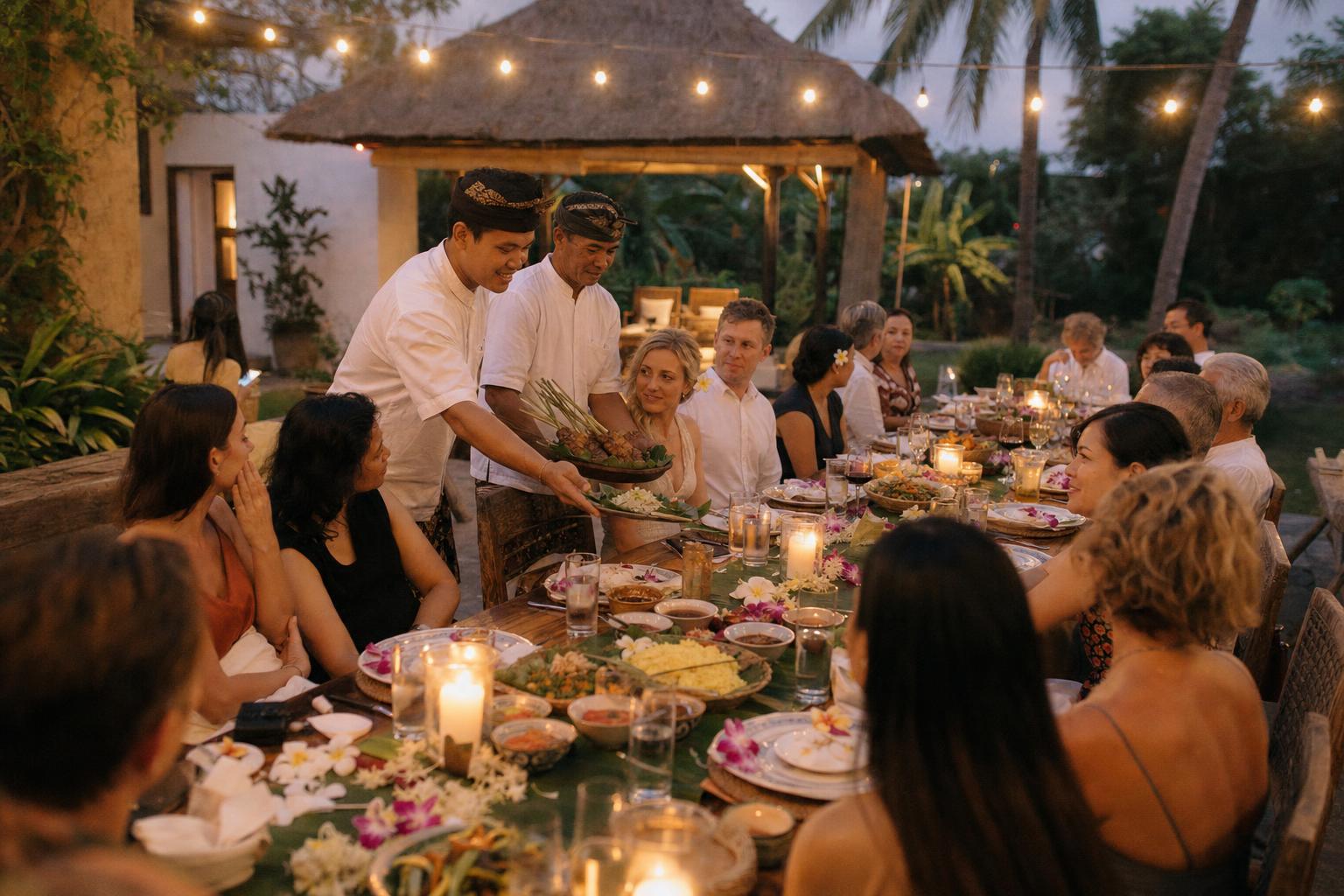
Family-style platters down one long table cost a little more than a buffet and far less than plated, and they feel the most generous of the three. A Balinese feast is my favourite version: sate lilit, ayam betutu, nasi kuning with sambal matah, and a whole babi guling if your guests eat pork. Ask for halal dishes if anyone needs them; Bali caterers can usually do it.
The bar
Indonesia taxes imported wine and spirits heavily, so the bar is the line that grows fastest. Balinese wine is the fix. Hatten, Sababay and Two Islands bottles sell for about 190,000 to 360,000 rupiah in Bali bottle shops, and local house wine is what the cheaper free-flow packages pour.
One mobile bar’s published free-flow of beer, local wine and soft drinks costs 480,000 rupiah a head for three hours and 635,000 for five, with staff and glassware, for a minimum of 30 guests. That is about 27 to 35 USD a head.
Shape it the way I describe in the real-cost guide: a welcome drink, beer and wine through dinner, and two signature cocktails. An arak cocktail makes a good local signature, as long as the arak is a branded, sealed bottle poured by a licensed bar. Australia’s Smartraveller still lists arak among the drinks involved in methanol poisonings.
Bringing your own only works with bottles you can show. Some resorts refuse duty-free alcohol and require Indonesian excise stamps on everything, and corkage runs 150,000 to 700,000 rupiah a bottle. The legal drinking age here is 21, which matters if younger cousins are coming.
Invitations
Our invitations range runs 200 to 800 USD, with digital-only at the bottom. Our free wedding invitation website takes it to zero: twelve designs, your schedule and travel details, replies straight to your own inbox, and a print version for the guests who still want paper. It also saves the international postage a printed suite needs when your guests live in four countries.
The legal part
A managed legal registration in Bali costs 700 to 1,500 USD for the process alone, with sworn translations, embassy fees and the religious ceremony on top, and it needs two to four months of runway.
At home it is usually a short appointment. A legal-only registry ceremony costs 400 AUD in Victoria from Monday to Thursday, and 482 AUD in New South Wales on selected weekdays, plus 70 for the certificate. Then Bali gets a commitment ceremony, from 1,500 USD, with nothing to file.
Three budgets, line by line
Here is how the money splits at three levels, built from the ranges on our own service and package pages. All three assume a symbolic ceremony with the legal part done at home, local suppliers, and about 10 percent held back for the exchange rate and late changes. Tax and service has its own line wherever a price is quoted ”++”.
About 10,000 USD: 20 guests, a Wednesday in May, a villa in Sanur or Ubud
| Line | USD | What it covers |
|---|---|---|
| Villa | 1,800 | Four bedrooms, three nights at about 600 a night, quoted nett |
| Event fee | 560 | The under-30 tier, about 10 million rupiah |
| Banjar | 200 | The contribution to the local village |
| Dinner | 800 | Indonesian family-style dinner, about 40 a head |
| Drinks | 600 | Welcome drink, beer, local wine and soft drinks for four hours |
| Tax and service | 300 | 21 percent on the food and drinks |
| Photography | 1,000 | Six hours, from the ceremony to the first dance |
| Flowers and styling | 800 | Local stems for the ceremony and one long table |
| Rentals | 500 | The long table, chairs, linen and festoon lights |
| Celebrant | 300 | A symbolic ceremony, script written with you |
| Music | 400 | An acoustic duo for the ceremony and dinner |
| Hair and makeup | 300 | The bride |
| Cake | 150 | One tier, real cake all the way through |
| Coordination | 900 | Day-of coordination |
| Generator and travel | 350 | A 20 kVA generator and supplier travel |
| Invitations | 0 | Our free invitation website |
| Buffer | 1,040 | About 10 percent |
| Total | 10,000 | About 500 a guest |
It leaves out video, a DJ, the bridal party in the makeup chair and imported flowers. It keeps a coordinator, a full ceremony with live music and six hours of photographs. And if three couples take the villa’s other bedrooms at their share of 150 USD a night, they cover 1,350 of the 1,800, which more than doubles the buffer.
About 18,000 USD: 35 guests, a Friday in late October, a villa in Tabanan or Ubud
| Line | USD | What it covers |
|---|---|---|
| Villa | 3,000 | Five or six bedrooms, three nights at about 1,000 a night |
| Event fee | 920 | The 30 to 59 tier, about 16.5 million rupiah |
| Banjar | 250 | The contribution to the local village |
| Generator | 250 | 40 kVA, which many villas require at this size |
| Dinner | 1,750 | Indonesian buffet with a grill station, about 50 a head |
| Drinks | 1,400 | Welcome drink, beer and local wine for four hours, two signature cocktails |
| Tax and service | 1,290 | 21 percent on the villa, food and drinks |
| Photography | 1,500 | Eight hours |
| Flowers and styling | 1,500 | Local stems, with the ceremony pieces moved to the tables |
| Rentals | 1,000 | Tables, chairs, linen and lighting |
| Celebrant | 350 | A symbolic ceremony, script written with you |
| Music | 900 | An acoustic ceremony set and a DJ until the curfew |
| Hair and makeup | 450 | The bride and two others |
| Cake | 200 | Two tiers |
| Coordination | 1,200 | Day-of coordination for around ten suppliers |
| Supplier travel | 400 | Higher outside the south |
| Rain plan | 0 | A covered pavilion at the villa that seats everyone |
| Buffer | 1,640 | About 9 percent |
| Total | 18,000 | About 515 a guest |
This is the same money as the 30-guest example in our budget guide. It holds five more people and keeps a buffer by giving up the video, choosing a Friday in the shoulder season, and picking an area where villas cost less.
About 25,000 USD: 50 guests, a Thursday in early September, a villa in Canggu or Sanur
| Line | USD | What it covers |
|---|---|---|
| Villa | 3,900 | Six or seven bedrooms, three nights at about 1,300 a night |
| Event fee | 920 | Still the 30 to 59 tier |
| Banjar | 250 | The contribution to the local village |
| Generator | 300 | Sized for a DJ and the kitchen |
| Dinner | 2,500 | Balinese family-style feast with one Western main, about 50 a head |
| Drinks | 2,000 | Beer, local wine and two signature cocktails for five hours |
| Tax and service | 1,760 | 21 percent on the villa, food and drinks |
| Photography | 1,500 | Eight hours |
| Flowers and styling | 2,000 | Local stems, a ceremony arch and the long tables |
| Rentals | 1,500 | Tables, chairs, linen, lighting and a dance floor area |
| Celebrant | 350 | A symbolic ceremony, script written with you |
| Music | 950 | An acoustic ceremony set and a DJ until the curfew |
| Hair and makeup | 750 | The bride, two bridesmaids and both mothers |
| Cake | 250 | Two tiers |
| Planning | 3,000 | Full planning from a local team |
| Transport | 500 | Supplier travel and two guest minibuses |
| Buffer | 2,570 | About 10 percent |
| Total | 25,000 | About 500 a guest |
Fifty guests at 25,000 USD is the bottom of the 25,000 to 42,000 range the real-cost guide gives for a wedding this size, reached on purpose: a Thursday before the school holidays, Balinese food, beer and wine, and no video. That is before any of the dozen guests sleeping in the villa pays for a room. If the buffer survives the final invoice, a short highlight film, around 900 USD, is the first thing I would add back.
When you want these numbers for your own day, send me your guest count, two or three possible dates and the figure you are working with. I will tell you where it stretches furthest. Give me the real number, because a plan built around a padded one helps nobody.
Questions couples ask
What is the cheapest way to get married in Bali?
For two people, a symbolic ceremony with a celebrant and a photographer, with the legal papers signed at home. A commitment ceremony starts around 1,500 USD, and a full elopement day runs 2,000 to 6,000. For a group, the cheapest version that still looks generous is a weekday in May or the green season, a villa in Sanur or Ubud, and family-style Indonesian food.
Is 5,000 USD enough for a wedding in Bali?
For an elopement, comfortably. With guests, 5,000 USD covers a short ceremony on a hired lawn or a permitted public spot, a few hours of photography and a set dinner at a restaurant for around ten people. A villa celebration for 20 starts nearer 10,000.
How do we tell whether a cheaper supplier is good enough?
Ask to see one complete wedding from each of them: a full gallery from a photographer, a tasting from a caterer, a florist’s work at a real event rather than a styled shoot. Then check that the contract lists hours, quantities and the overtime rate. A cheap quote with all three written down is a good sign. A cheap quote that goes vague when you ask is the warning.