The real cost of a Bali wedding
The quote you are given is rarely the number you pay. Here is every fee that shows up in between: the ++, villa minimums, the banjar contribution, corkage, overtime, and how to see all of it before you sign.
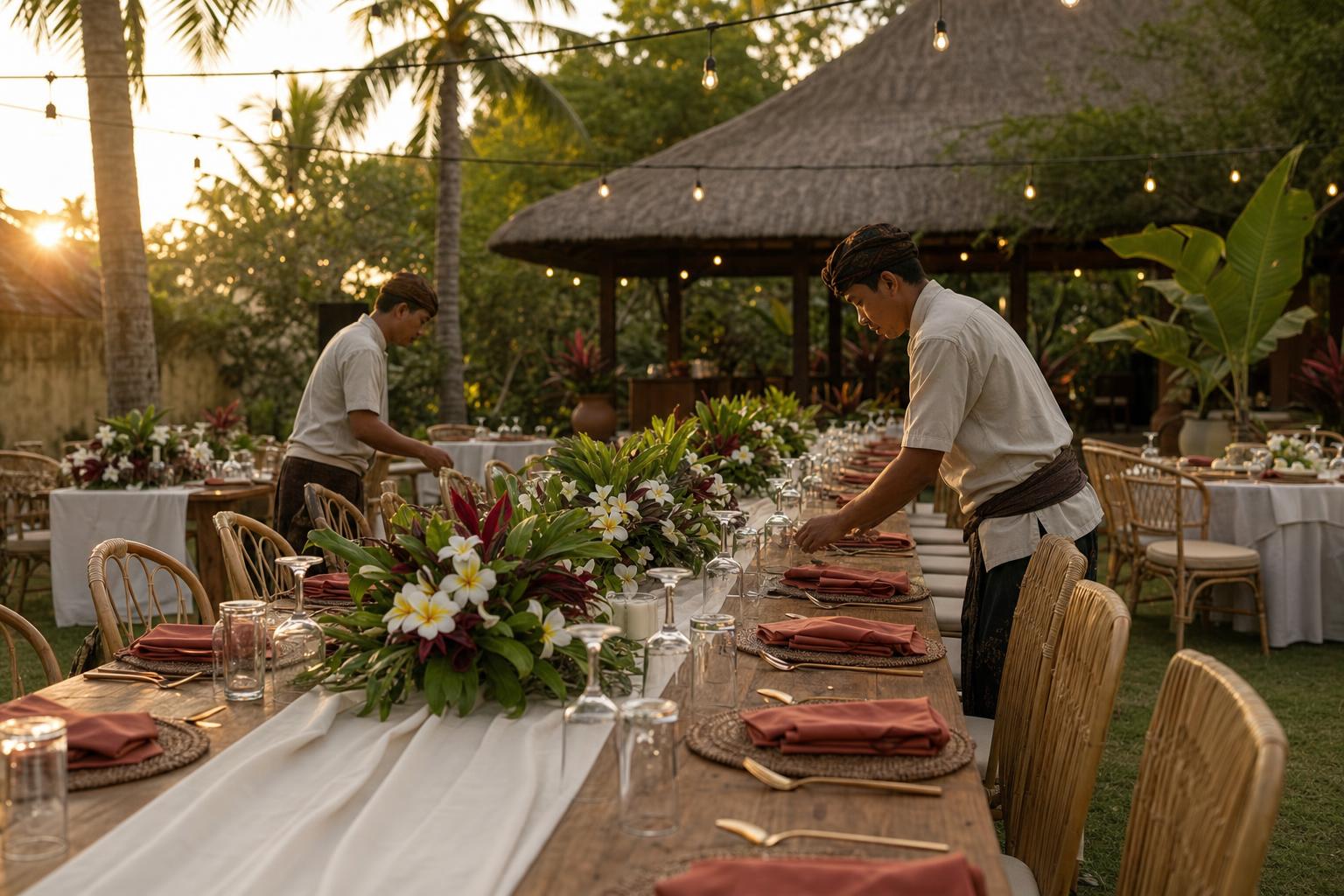
Two couples can book the same villa, on the same date, at the same headline price. One of them pays close to half as much again. Nothing went wrong and nobody was cheated. They signed different things, and only one of them knew it at the time.
That gap is what this guide is about. If you want the ranges first, what a Bali wedding typically costs sets out the bands by guest count. This page covers the distance between the number on the proposal and the number on the final invoice.
I made a short video walking through the same ground, if you would rather watch than read.
Every average price you have read is a guess
A quiet elopement for two on a clifftop and a 100-guest celebration at a luxury villa are not the same wedding. They are not even in the same conversation. So when a website hands you a single average, it has told you nothing about your day.
What helps you is knowing which levers move your number. There are five, and you control most of them.
Your guest count. By a distance the biggest. Catering, venue size, staffing, furniture, flowers down the middle of every table: almost all of it grows with the list. Two couples at the same venue can pay wildly different totals purely because one invited 30 people and the other invited 90.
Your venue and how much it includes. Some venues quote a higher fee that already covers tables, chairs, sound and basic lighting. Others hand you a beautiful empty space and you rent every single item on top. A venue that looks cheaper at first can finish more expensive. Ask what is included before you fall in love with the place, not after. The region matters as much as the property, and where to get married in Bali compares what each area does to your budget as well as to your photographs.
How much you want handled for you. At one end, a celebrant, a few rows of chairs, a bouquet and a photographer. At the other, a floral arch, styling on every table, a multi-course dinner, a band, hair and makeup for the whole party. You end up equally married. The cost is nowhere near the same.
Your season and your date. A Saturday in July, when the weather behaves, is the most wanted slot in Bali. The best venues and vendors book far ahead and hold their prices. Move to a weekday, or to a quieter month, and there is suddenly room to negotiate. The wedding does not change. The date has a price. The best time to get married in Bali goes through what each month costs you in rain, crowds and rupiah.
Legal or symbolic. A blessing is about the moment and carries no paperwork. A legal marriage in Indonesia involves documents, officials and a process that depends on your nationality and religion. It is very doable, and it adds steps that cost money and time. I go through the whole trade-off in can you get married in Bali legally.
Wherever you land on those five, the money concentrates in two places: the venue, and feeding everyone. Photography, flowers and music matter enormously to how the day feels, and they are still not what moves your total.
The gap between the quote and the invoice
Here is the part I most want you to read, because it is where couples get caught.
A Bali wedding package advertised at 250 million rupiah, around 13,900 USD, is a real price for a real thing. It is rarely the price of your wedding. Below is what tends to sit in the space between.
The ”++” is 21 percent, and it compounds
When you see a price written as “150,000,000++”, those two plus signs mean government tax and service charge are added on top.
The arithmetic catches people out because it is not a flat 20 percent. Service is added first, then tax is calculated on the new total. Take a base of 100 million rupiah at a venue charging 10 percent service and 10 percent tax: service takes it to 110 million, then tax applies to that, giving 121 million. So ”++” is 21 percent, not 20.
On a 10,000 USD food and beverage bill, that is 2,100 USD you did not see in the headline. Some venues run 5 percent service instead of 10, which lands you at 15.5 percent. Ask which applies, and ask for an invoice that separates base, service and tax.
The word to look for is “nett” or “net”. A nett price already contains everything. A ”++” price does not.
Villa minimum stays and the function fee
This is the single biggest surprise in villa weddings, and it comes in two parts.
First, most wedding villas require a minimum stay, commonly three nights and sometimes up to seven, often longer over a weekend. Second, they charge a separate function fee for holding an event on the property, on top of the nightly rate. It covers the extra staff, the wear, and the simple fact that a wedding is not a normal stay.
A useful rule of thumb: the function fee is often close to one more night’s rent.
The fee usually steps up with guest numbers. One villa I work with charges roughly 7 million rupiah when only house guests attend, 10 million under 30 guests, 16.5 million under 60, and 50 million once you go past 60. That is 390 USD at the bottom and 2,780 USD at the top, for the same property, on the same night.
So the nightly rate you found online can genuinely be less than half the story.
The banjar fee
Your venue sits inside a banjar, the local village community. Holding an event on their land means a customary contribution to that community. It is completely normal, it is part of doing things respectfully here, and it pays for things you actually benefit from: parking staff, security, traffic, and the goodwill of the neighbours you are about to keep awake.
Budget 3 to 8 million rupiah, roughly 170 to 450 USD, scaling with guest count, music and parking pressure. Some venues charge it again if you add a welcome dinner the night before.
The problem is never the fee. The problem is meeting the word “banjar” for the first time on your final invoice. A planner books it in from day one.
Drinks, and the reason imported alcohol hurts
Indonesia taxes imported alcohol heavily, so a free-flowing bar all night can quietly become one of the largest lines in the whole wedding.
Bringing your own does not automatically solve it either, because venues charge corkage. Expect anywhere from 150,000 rupiah a bottle at a relaxed villa to 350,000 for wine, 500,000 for champagne and 700,000 for spirits at a premium clifftop resort. That is 8 to 40 USD per bottle before anyone drinks anything.
Your duty-free allowance of about one litre each will not provision a wedding, so do not build a plan around it.
The move that saves the most without anyone noticing: a proper welcome drink, beer and wine through dinner, and two signature cocktails. It reads as generous and costs a fraction of an open bar for eight hours.
Vendor transport, overtime and extra guests
Small lines that add up quickly.
Most suppliers charge travel from their base in the south. Around Sanur or Seminyak that might be 350,000 rupiah, Uluwatu closer to 600,000, Ubud 850,000, and the far east or Tabanan around 900,000. Multiply by the number of separate suppliers coming to you, because florists, furniture, beauty and production all bill their own.
Overtime is the one that bites at the end of the night. A photo and video crew running past their contracted hours commonly costs 1 to 2.5 million rupiah an hour, roughly 55 to 140 USD. Standard coverage is often eight to ten hours, and sound curfews in most areas fall between 10pm and midnight.
And packages include a fixed head count. Additional guests are charged per person, from 150,000 rupiah for ceremony seating to 2.5 million for full food and drinks.
Generators, and a real rain plan
Many villas require an independent generator, sometimes a minimum of 40 kVA, because a wedding’s lighting, sound and kitchen load will trip a domestic supply. Hire runs from about 2.5 million rupiah for 20 kVA to 8.5 million for 100 kVA, usually for eight hours, with overtime on top.
Then there is weather. Bali’s wet season runs roughly November to March, and an outdoor wedding in those months needs somewhere for 60 people to eat if it pours. A marquee commonly runs 20 to 30 million rupiah, and a large one considerably more. Some villas make it compulsory in the wet months.
A traditional rain-stopper is part of local practice and costs around 5.4 million rupiah. I have seen it work and I have seen it not. Book it if it gives you comfort, and book a roof as well.
Flowers, local against imported
Local tropical flowers are beautiful, abundant and cheap. Frangipani, heliconia, orchids, palm and banana leaf all grow here.
Peonies, hydrangeas and ranunculus do not. They arrive by plane, they arrive with minimum order quantities, and premium imported stems run 150,000 to 300,000 rupiah each, 8 to 17 USD, for a single flower.
A local scheme for 20 guests starts around 12 to 18 million rupiah. Ask for the same look in imported blooms for 50 guests and you are at 18 to 36 million, with large installations running far past that. Our floral design team will always show you the local version of a reference photo first, because nine times out of ten it is the better answer.
If your Pinterest board is full of pale European flowers, that is worth knowing in month one rather than month six.
The legal paperwork
If you want the marriage legally recognised in Indonesia, allow 18 to 45 million rupiah, around 1,000 to 2,500 USD, for a managed legal registration service. That covers the civil registry, translations, and the document handling that varies by nationality and religion. Allow four to six weeks minimum, and more if your embassy is slow with a certificate of no impediment.
Most of my international couples sign at their own registry office at home, quietly, weeks before they fly. Then Bali is purely the celebration. It is cheaper, faster, and changes nothing about the day itself.
What that does to a real number
Put it together. Start from that advertised 250 million rupiah package, about 13,900 USD, and build the honest version:
- Add 21 percent where the quote says ”++”: roughly 52 million rupiah, or 2,900 USD.
- Add the villa minimum stay and function fee where the package assumed you had a venue: commonly 100 to 250 million, or 5,600 to 13,900 USD.
- Add banjar, security and local permissions: 3 to 10 million, or 170 to 560 USD.
- Add alcohol, production, vendor transport, overtime and the rain plan: often 50 to 200 million, or 2,800 to 11,100 USD.
- Add legal registration if you want it: 18 to 45 million, or 1,000 to 2,500 USD.
- Hold 10 percent back for currency movement and late changes.
A 13,900 USD headline becomes a credible final invoice somewhere between 25,000 and 42,000 USD, before anyone’s flights and often before guest accommodation.
That is not a scandal. It is what a wedding for 50 people in Bali costs when everything is on the page. The scandal would be finding out in stages.
If you want to build your own version of that number rather than trust mine, our wedding price simulator runs on the same figures as this guide, including the event fee, the banjar and the ”++” toggle.
Deposits, payment terms, and the exchange rate
Three practical things nobody mentions until you are signing.
Deposits are large and usually non-refundable. Expect 25 to 50 percent to hold a date, and most villas and hotels want 50. On a 500 million rupiah wedding that is 250 million, about 13,900 USD, transferred months in advance. Balances typically fall due 30 to 60 days out, and some resorts want 90.
There is often a security deposit too, commonly 5 to 30 million rupiah, refundable after the event but still money you need to have.
You are paying in rupiah, whatever the website shows. Indonesian transactions settle in IDR, so a USD figure in a brochure is a reference, not a fixed price. At the end of July 2026 the rate sits around 17,900 to 18,100 rupiah to the dollar. If it moves to 16,000 before your final payment, a 500 million rupiah invoice climbs from about 27,800 USD to 31,250, an extra 3,400 for a wedding that did not change.
Two habits protect you. Keep one currency in the contract and know who absorbs the bank fees. And if you are paying by card, refuse dynamic currency conversion at the terminal, because the 2.5 percent card surcharge is usually not the worst part of that transaction.
Six honest ways to spend less
None of these make a wedding look like corners were cut.
- Trim the guest list. The most powerful lever you have, and the only one that reduces almost every other line at once. A smaller, warmer wedding is often the better day anyway, and how to elope in Bali shows what the day looks like taken all the way down to two.
- Move your date. Off peak season, or simply off a Saturday. Same wedding, meaningfully less money.
- Handle the legal part at home. A blessing here, the signature there. Skips the paperwork and its cost.
- Spend where it shows. Your guests will remember the food, the atmosphere and the photographs. Nobody has ever remembered a chair cover.
- Rethink the bar. A welcome drink and two signature cocktails instead of eight hours of open bar. This one is worth thousands.
- Bundle, and use someone local. Booking every vendor separately almost always costs more than a package, and a local planner reaches rates you cannot get from abroad.
That last point is worth being blunt about. Quotes in Bali move depending on who is asking. A couple emailing from overseas, with no local reference and no sense of what things should cost, is quoted differently from someone who books that venue eight times a year. Our wedding planning team works from Sanur and pays local rates, and that difference usually covers the fee on its own.
So is Bali actually cheaper than home?
For most couples from Australia, the UK, the US and Singapore, yes, and by a distance. The same 60-guest wedding at home frequently costs more than the Bali version including everyone’s flights, because labour, catering, flowers and venue hire all sit at a different level here.
The catch is that the saving only materialises if you get real local pricing and see all the fees at the start. Paid badly, a Bali wedding can cost you what a wedding at home would, with the added excitement of discovering new charges by email at 2am.
What to do with all this
Ask three questions of every quote you receive, and you will avoid almost everything on this page.
Is this price nett or ”++”? What is not included? And what will you charge me for that is not on this document?
Any decent supplier answers all three without flinching. If a quote gets vague at that point, you have learned something useful for free.
When you are ready for a real number rather than a range, send me your date, your rough guest count and the kind of day you have in mind. I will come back with a proper breakdown for your wedding, with the banjar in it, the function fee in it, and the ”++” already calculated. It costs nothing, and it is a much better starting point than an average.